





What legal obligations apply to companies with 10, 20, 50 and 100 employees?

What legal obligations apply to companies with 10, 20, 50 and 100 employees?

The year 2026 marks the concrete implementation of the government agreement adopted the previous year. This development has resulted in the adoption of several new legal provisions, particularly in social security law and labour law, as reflected by our various newsletters published throughout the year. These developments lead to new obligations for both employees and employers.

Moreover, within the complex framework of Belgian social law, companies must also remain attentive to the legal obligations that apply to them depending on their size. Indeed, certain measures only become mandatory once a specific workforce threshold is reached.

This article aims to provide you with an overview of the main obligations under Belgian labour law related to the number of employees.

NB: Please note that the method used to calculate the number of employees to determine whether an obligation applies to a company varies depending on the specific obligation. In some cases, legislation provides for a specific calculation method.

1. Summary of legal obligations according to company size

Company sizeObligationDescription
Individual training rightOnly where required by a sectoral CLA.
10 to Individual training rightMinimum 1 day/year/FTE; formal and informal training recognized. Exceptions possible via sectoral CLAs.
Mobility budgetObligation to introduce a mobility budget from 15 employees (entry into force from 2028 – to be confirmed).
≥ 20 employeesRight to disconnectMandatory policy via CLA or working regulations (modalities, obligations, etc.)
Employment plan for older employees (CLA 104)Annual plan to maintain/increase the employment of workers aged 45+.
Individual training right (5 days)Average of 5 days/FTE over 5 years. Exceptions possible via sectoral CLAs.
Annual training planPlan to be established before 31 March; mandatory consultation of employee representatives.
Internal service for prevention and protection at workObligation to organize an internal service; the prevention advisor must be an internal employee.
Work potential evaluationMandatory from 8 weeks of incapacity for work.
Reintegration processObligation to initiate a process within 6 months from the first day of incapacity for work.
≥ 50 employeesSocial elections – CPPWMandatory organisation every 4 years.
Person of trustMandatory designation of at least one internal person.
Mobility budgetObligation to introduce a mobility budget (from 2027 – to be confirmed).
Report on wage gapBiennial report using the simplified form.
NSSO solidarity contribution in the event of long-term illnessObligation to pay a solidarity contribution for two months for workers aged from 18 to 54 years old who have been unable to work for more than 30 days.
≥ 100 employeesSocial elections – WCMandatory organisation every 4 years.
Gender pay gap reportBiennial report via full form.

2. Details of the obligations

<10 employees

1. Individual training right

There is no general legal obligation to grant training days (individual right) except where this is provided for by a sectoral collective labour agreement (CLA).

From 10 to <20 employees

1. Individual training right

All employees in the companies concerned have an individual right to training. Only formal and informal training courses as defined by law are considered for this individual right.
Companies employing between 10 and fewer than 20 employees (in FTE) are required to guarantee at least 1 day of training per year and per FTE.

Please note that sectors (joint committees) may lay down specific rules in this respect (number of training days, formalities, etc.).

For more information on this obligation and the related procedures, we invite you to consult our newsletter of 19 February 2026.

2. Mobility budget (as of 2028)

Companies employing at least 15 employees will be required to introduce a mobility budget. All concerned employees will be able to opt for this budget, in accordance with the modalities defined in the internal policy. For more details about the mobility budget, please see our newsletters dated 25 January 2024, and 26 April 2022.

At this stage, no draft legislative text has yet been published, meaning that the full scope of this obligation is not yet known.

This obligation is expected to enter into force on 1 January 2028, subject to the publication of a legislative text in the Belgian Official Gazette.

As from 20 employees

1. Right to disconnect

The right to disconnect is the employee’s right not to be available through professional digital tools (such as mobile phones, email, and communication tools used by the company, etc.) outside working hours.

Companies employing at least 20 employees are required to implement such a policy through:

  • either a company-level CLA,
  • or the working regulations.

The policy must at least set out the modalities for applying the right to disconnect, the rules governing the use of digital tools, periods during which employees should not be contacted, etc.
We can provide you with a standard clause to be included in your working regulations.

2. Plan for the employment of older employees (CLA nr. 104)

Companies employing more than 20 employees (FTE) are required to draw up a plan for the employment of employees aged 45 and over. This plan must be established on an annual basis.

It is adopted following an information and consultation procedure that must start within 3 months of the end of the financial year, generally by 31 March.

The plan includes measures aimed at maintaining or increasing the number of employees aged 45 and over. To this end, the employer may choose from a (non-exhaustive) list of areas of action provided for in the CLA, including:

  • the selection and recruitment of new employees;
  • the development of the employees’ skills and qualifications, including access to training;
  • career development and professional guidance within the company;
  • etc.

We can provide you with a plan template and assist you in completing it.

3. Individual training right and annual training plan

Companies employing at least 20 employees in FTE are subject to a double obligation:

  • to comply with an individual right to training of 5 days per year per full-time employee (average over a period of 5 years);
  • Prepare an annual training plan and communicate it to and/or consult on it with the employee representatives (Works Council, Committee for Prevention and Protection at Work, or Trade Union Delegation) no later than 31 March, unless a sector-specific derogatory regime applies. Within one month of its entry into force, the plan must be registered electronically with the competent authorities.

Please note that sectors (joint committees) may lay down specific rules in this respect (number of training days, formalities, etc.).

We can provide you with a template plan and assist you in completing it and submitting it to the relevant Belgian authorities.

For more information on the training plan and the procedure for drafting and filing it, we invite you to read our newsletters of 12 March 2024 and 17 February 2025.

4. Organisation of the internal service for prevention and protection at work

All companies must establish an internal service for prevention and protection at work (ISPPW) with at least one prevention advisor. In companies with at least 20 employees, the internal prevention advisor must be an employee of the company and can no longer be the employer.

It is recommended to draw up an addendum to the employment contract of the appointed prevention advisor in order to formalize this role and the responsibilities associated with it.

In addition, the appointment of the prevention advisor must follow a specific procedure. Finally, the prevention advisor must have appropriate and specific training corresponding to their level of function.

5. “Work potential” evaluation and reintegration process

In January 2026, the Code on Well-being at Work was amended to introduce an obligation for employers to request an assessment of the employee’s “work potential” in the event of incapacity for work as from 8 weeks of absence.

Where the assessment concludes that there is work potential, employers employing at least 20 employees are required to initiate a reintegration process within 6 months following the start of the incapacity for work.

These obligations apply to all cases of incapacity for work starting from 1 January 2026.

As from 50 employees

1. Social elections – Committee for Prevention and Protection at Work (CPBW)

Companies employing at least 50 employees during a specific reference period provided for by law are required to organize social elections every four years to elect employee representatives to the Committee for Prevention and Protection at Work (hereinafter “CPBW”).

The CPBW is a consultative body composed of representatives of the employer and the employees and has as its main task to ensure well-being at work by providing advice and participating in the implementation of safety measures. Once the CPBW has been established, the company is required to consult it on numerous matters relating to well-being, prevention, internal policies, etc.

The next social elections will take place in 2028.

2. Trusted person – general obligation

The appointment of at least one trusted person is mandatory in companies employing 50 employees or more. At least one trusted person must be an internal staff member.

The trusted person must have completed specific training of at least five days within two years following their appointment.

3. Gender pay gap report (analysis of the remuneration structure)

Companies that usually employ an average of at least 50 employees are required to draw up a remuneration structure analysis report every two years. The purpose of this report is to identify, and remedy pay gaps between men and women.

  • Companies employing between 50 and 99 employees must comply with the abbreviated form;
  • Companies employing ≥ 100 employees must comply with the full form.

The above-mentioned forms (in Dutch or French) are made available by the competent authorities and can be accessed via the following :

Furthermore, if you are a Pro-Pay payroll client, we are able to provide you with a completed report based on the data recorded in our payroll system.

4. NSSO solidarity contribution in the event of long-term illness

A solidarity contribution is due by employers employing an average of at least 50 employees for workers aged 18 to 54 who have been in incapacity for work for more than 30 days. Temporary agency workers, flexi-job workers, and occasional workers in certain specific sectors are excluded from this measure.

The contribution amounts to 30% of the incapacity-for-work benefit received by the employee for a period of two months starting from the 31st day of incapacity for work. This contribution is collected automatically by the National Social Security Office (NSSO).

On 18 July 2026, the Council of Ministers approved a preliminary draft legal text extending the obligation to pay the solidarity contribution for an additional two months. As a result, the contribution would also apply during the 4th and 5th month of incapacity for work. The additional revenue generated by this contribution would be returned in full to the companies concerned, regardless of whether they actually paid the contribution.

This measure remains subject to the publication of the relevant legislative text in the Belgian Official Gazette.

5. Mobility budget (as of 2027)

Companies employing at least 50 employees will be required to introduce a mobility budget. All concerned employees will be able to opt for this budget, in accordance with the modalities defined in the internal policy.

At this stage, no draft legislative text has yet been published, meaning that the full scope of this obligation is not yet known.

This obligation is expected to enter into force on 1 January 2027, subject to the publication of a legislative text in the Belgian Official Gazette.

As from 100 employees

1. Social elections – Works council

Companies that usually employ an average of at least 100 employees during a specific reference period provided for by law are required to organize social elections every four years to elect employee representatives to the Works council. If a Works council already exists, renewal through social elections becomes mandatory as from 50 employees.

The underlying obligation linked to the establishment of a Works council is to inform and consult it on several matters (economic situation, employment structure, work organization, etc.).

Action point: It is therefore essential for companies to be aware that their size may – or may not – trigger the application of certain obligations under social law, in order to ensure compliant and efficient management.

If you have any questions regarding any of these obligations or would like an overview of the requirements applicable to your company, please do not hesitate to contact us at legal@pro-pay.be.

Pay transparency is not just about reporting: what the directive actually focuses on and how to be prepared as an employer

Pay transparency is not just about reporting: what the directive actually focuses on and how to be prepared as an employer

Even though the deadline of 7 June 2026 for transposing the EU Pay Transparency Directive has passed, many questions and comments remain about its content.

Belgium has not met the deadline of 7 June 2026 to transpose the Directive. It has requested a six-month extension from the European Commission and has raised several questions regarding the practical application of the directive, including what should be considered as “pay.”

Although Belgium has not yet transposed the directive, there are many important preparatory steps companies can to take to ensure they are ready for its transposition.

Below, we provide an overview of the common misconceptions and outline the most important measures that a company will need to take to be prepared for the transposition of the directive.

Common misconceptions about the EU Pay Transparency Directive

❌ “Employees will be able to know exactly
how much their colleagues earn.”

✔︎ The directive was never intended to mean that employees
would know their colleagues’ exact salaries. It does grant
employees the right to request, in writing, information about their
own pay level and the average pay levels by gender for employees
performing the same or equal work.

❌ “The Pay Transparency Directive requires
employers to carry out benchmarking.”

✔︎ The directive does not require companies to have a market
benchmark in place to comply with its obligations. Rather than
imposing external benchmarking, the directive primarily requires
employers to ensure that their internal pay structures are objective,
gender-neutral, and based on clear criteria. A benchmark can be
a useful tool to support and validate these structures, but is
not necessary for compliance.

❌ “We have fewer than 100 employees, so we
don’t need to take any action at this stage.”

❌ “As the directive has not yet been transposed
into national law, we can simply wait until the
national legislation is published.”

✔︎ It is important for employers to fully understand the impact
of the directive and the extent of the preparatory work required,
regardless of company size or the timing of national transposition.
Even companies with fewer than 100 employees, which are not
subject to formal reporting obligations, remain impacted by all other
requirements that can have a significant operational effect. Pay
transparency requires organising pay in a fundamentally different way.

❌ “It will no longer be possible to grant different
salaries to employees within the same category.”

✔︎ Organizations that have not already start reviewing their job
classification systems and salary policies risk not being able to
respond to employees’ requests under their right to information
once the directive is implemented. If such requests reveal that equal
work is not being rewarded equally, this may lead to further review
or action. While the Directive requires equal pay for equal work or
work of equal value, it does allow differences in remuneration within the
same category, provided these are based on objective and
gender-neutral criteria.

The Directive provides for penalties for infringements of national provisions established in accordance with the Directive and relating to the right to equal pay. Such penalties will include fines. Furthermore, employees who have suffered damage/loss as a result of a breach of a right or obligation related to the principle of equal pay shall have the right to claim a retroactive compensation, as will be determined by the Member State. This entails full payment of outstanding remuneration, as well as related bonuses or benefits in kind, etc.)

Key measures to take ahead of the Directive’s transposition

Pay differences should be understood, their underlying causes recognised and employers should be able to explain why they exist. This starts with a clear job evaluation system and a consistent salary policy. The steps below set out how companies can put this into practice.

1. Review and update your job classification system

You should be able to demonstrate that jobs of equal value are remunerated equally. This requires clear job classifications, objective criteria and the identification of inconsistencies.

The EU Directive and the Commission clearly state that only a limited number of objective criteria will be accepted to determine the different salary categories. These criteria must be aligned with the four factors set out in the Directive: skills, effort, responsibility and working conditions. A formal job classification methodology should be introduced, if your organization does not have one yet. This does not necessarily imply the implementation of a complex system. The European Commission provides accessible guidance and practical tools for gender-neutral job evaluation.


➥ Pro-Pay can help you review your current job architecture and verify whether it meets the standards and expectations outlined in the Directive. We can assist you in finding a formal job classification methodology that suits your organisation. Given the importance of such a system in ensuring objectivity as required by the directive, this exercise can already begin, while implementation and alignment of HR practices may take time.

2. Analyse your remuneration data

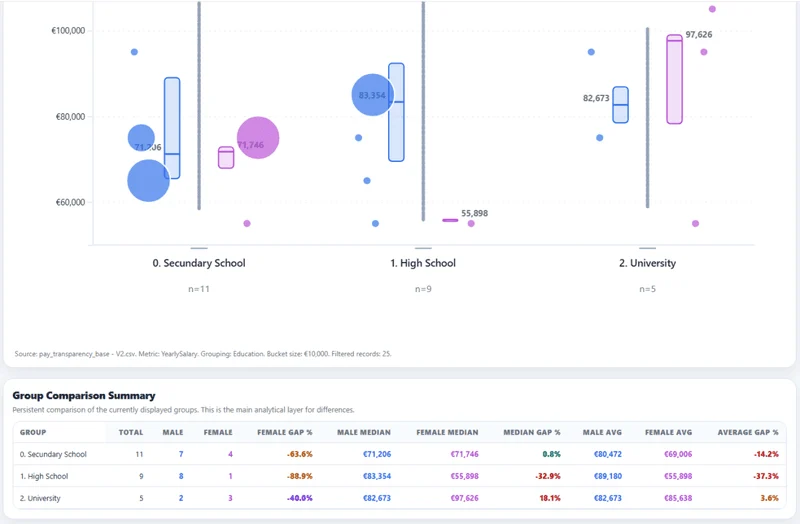
Many organisations have the data but lack the insights. It is therefore important to analyse salary differences (for example, between men and women) and identify risks such as unexplained gaps.

Not only the gross salary but the total remuneration package must be taken into account. Often, the biggest differences will be found in the total remuneration component, as this includes extra benefits negotiated by employees. A complete compensation dataset with every pay element mapped per employee is necessary to be able to do a gender pay gap analysis.

➥ Pro-Pay can assist you using our tool to verify whether there is a pay gap and, if so, how significant it is, based on the available data.

Chart comparing pay data for pay transparency


Preview of the tool

3. Document your salary policy

The burden of proof is shifting to the employer. Ensure it is clear how salaries are determined and that decisions regarding pay rises and promotions are properly documented.

➥ Pro-Pay can assist you with drafting and analysing your remuneration policy. We can assist with adapting existing salary policies to the requirements of the directive, such as setting midpoints, salary increases, mitigating outliers, etc.

4. Adapt your recruitment process

Salary ranges must be clear from the outset and recruiters must conduct interviews differently. Transparency begins before the start of employment.

➥ Pro-Pay can provide you with more detailed information on this step, based on the European Commission’s guidelines.

Do not hesitate to contact us for more information at legal@pro-pay.be. In addition, we invite you to register for our webinar series if you wish to stay informed about the latest legislative developments or deepen your knowledge of specific employment law topics. In December, we will be hosting a webinar entirely dedicated to pay transparency. More information is available on our website.

Change of target group reduction for the first hiring 2026

Change of target group reduction for the first hiring 2026

“New” employers in Belgium who hired a first employee, benefit from a partial reduction from social security contributions during the entire period of employment of this first employee. This is called the ‘target group reduction first hiring’.

This target group reduction has already been amended several times over the past few years. On 1 July 2026, a number of changes were introduced again. Below is an overview of these changes.

Reminder of the concepts

“A new employer” is an employer who has never been subject to Belgian social security, or who has not been subject to it for at least 12 consecutive months preceding the starting date of the first employee. Moreover, the company may not belong to the same so-called ‘technical business unit’ with another company.

The term ‘technical business unit’ is also explicitly defined. Two or more companies form a technical business unit together if there is a social link (at least one common person in the companies) and if there is a socio-economic interdependence (this is assessed on the basis of activities, location, clientele, material, personnel management, etc.).

Changes

1. First hiring

The employer’s social security contribution for a white-collar worker in Belgium amounts to approximately 25% of the gross salary (depending on the competent joint industrial committee). Until 30 June 2026, the amount of the reduction for the first hire was capped at 3,100 EUR per full quarter.

As from 1 July 2026, this amount was reduced to 2,000 EUR per quarter. This target group reduction can still be applied for an unlimited period of time.

In practice, this lower cap only affects full-time gross monthly salaries exceeding 2,666 EUR per month. For a full-time employee who earns a maximum of 2,666 EUR gross per month, the employer will not have to pay any social security contributions. For full-time employees with a higher gross monthly salary, the employer’s contribution is reduced by a maximum of 2,000 EUR per quarter. This is illustrated by the following example.

Example: A full-time employee earns 2,666 EUR gross per month. This amounts to 7,998 EUR per quarter. We then take 25% of 7,998 EUR, which comes to 1,999.5 EUR. The first 2,000 EUR is exempt from social security contributions.

! If you have an employee with a target group reduction first hiring, you do not need to take any action yourself. We will automatically calculate the reduction for you. If the gross monthly salary of the employee, for whom you currently benefit this target group reduction, exceeds 2,666 EUR gross per month, take into account that your salary costs will increase.

2. Second to fifth hiring

In 2024, the reductions for the fourth to the sixth hired employees were abolished. Until 30 June 2026, employers were only entitled to a target group reduction for the first three hired employees. Furthermore, the reduction for the second and third hired employee remained in force for only 12 quarters, with the amounts decreasing over the course of that period.

From 1 July 2026, the reductions for the fourth and fifth hired employee will be reintroduced. From that date, employers will be able to benefit from a lump-sum reduction of 1,000 EUR per quarter for the second to the fifth hired employee. These target group reductions can be applied for a maximum of 12 quarters within a period of 20 quarters after the recruitment.

3. Transitional measures

The following transitional measures apply to current reductions for the first, second or third hiring:

  • for the first hiring: from 1 July 2026, the maximum reduction amount will also decrease to 2,000 EUR per quarter (instead of the current 3,100 EUR per quarter);
  • for the second and third hiring where the entitlement took effect before 1 July 2026, the reduction may continue to be applied unchanged in accordance with the old rules for the remaining quarters.

Overview

Finally, we provide a brief overview of the target group reductions as from 1 July 2026. These are the maximum amounts per quarter applicable in the event of full quarterly performances.

HiringReduction applicable before 1 July 2026Reductions as from 1 July 2026
FirstUntil 1 July 2026: 3,100 EUR As from 1 July 2026: 2,000 EUR2,000 EUR (unlimited in time)
Second1,550 EUR – 5 quarters 1,050 EUR – next 4 quarters 450 EUR – next 4 quarters1,000 EUR, for a maximum of 12 quarters
Third1,050 EUR – 9 quarters 450 EUR – next 4 quarters
Fourth–
Fifth–
Sixth––

Key changes to the flexi-job scheme

Key changes to the flexi-job scheme

A law fundamentally reforming the flexi-job scheme was recently approved and adopted by Parliament. The law has in the meantime been published in the Belgian Official and entered into force on 1 July 2026.

In this newsletter, we first provide a brief reminder of the basic rules governing the flexi-job scheme, followed by an overview of the main changes introduced by this reform.

1. What is a flexi-job?

A flexi-job is a form of secondary employment that allows an employee to perform additional work for one or more other employers alongside their main employment, provided that certain conditions are met. The scheme is also available to retired employees.

Eligible employees

Any employee working at least 4/5th of a full-time working time may take up a flexi-job with one or more other employers. This condition must be met during the 3rd quarter preceding the flexi-job employment.

Retired employees may also use this type of employment. However, the recent reform introduces certain changes to the eligibility conditions for this category (see section 3).

Flexi-job agreements

Two agreements must be concluded between the employer and the flexi-job employee:

  1. Framework agreement: This agreement reflects the parties’ intention to enter into a flexi-job arrangement. It also outlines the general terms and conditions governing the flexi-job employment with the employer. The framework agreement must be concluded in writing prior to the start of the first flexi-job.
  2. Employment agreement: This is the fixed-term employment contract or the contract for a clearly defined work that governs the employee’s effective employment under the flexi-job scheme.

Remuneration and benefits

The remuneration of a flexi-job employee must be specified in the framework agreement. It consists of a base salary together with all benefits and allowances linked to the employment under the employment contract (such as sector-specific bonuses, statutory allowances, etc.). The base salary must be at least equal to the sectoral salary scale applicable to an equivalent position or, where no such salary scale exists, to the guaranteed average minimum monthly income (GAMMI). The legislation also provides for a salary cap (see section 4 below).

The flexi-job remuneration is exempt from employees’ social security contributions (only a special employer social security contribution is due) and from income tax, provided that it does not exceed the annual threshold of EUR 18,440. This annual threshold does not apply to retired flexi-job employees.

2. Eligible sectors

Initially, the use of flexi-jobs was limited to a number of specific sectors. However, the reform extends the scheme to all sectors.

As a result, any employer may now use the flexi-job scheme, regardless of its sector of activity, unless the relevant sector has expressly introduced exclusions (“opt-out”) or restrictions through a sectoral collective labour agreement.

Among others, joint committees 144, 145, 116, 207, 124, 226 and 307 have introduced sector-specific exclusions or restrictions.

3. Pension and flexi-job

The flexi-job scheme remains available to retired employees. However, the reform has simplified the eligibility conditions.

From now on, it is sufficient for the employee to have retired status during the quarter (Q) in which they start their flexi-job. Previously, this status had to be verified in the second quarter (Q-2) preceding the start date of the flexi-job, which resulted in a waiting period. This requirement has now been abolished.

In this respect, the employer may ask the retired employee to provide evidence that they meet the eligibility conditions for the flexi-job scheme.

4. More flexible maximum remuneration

The base salary which can be granted under a flexi-job may not exceed 150% of the minimum base salary foreseen by the applicable sector for an equivalent position or, where no sectoral minimum salary exists, 150% of the guaranteed average minimum monthly income.

Allowances, bonuses and other benefits provided for by law or by sectoral provisions are not taken into account when determining this maximum base salary.

A specific cap applies in the hospitality sector, where the maximum salary is set at EUR 21 per hour.

If you have any questions regarding the above, please do not hesitate to contact us at legal@pro-pay.be.

If you would like to stay informed about the latest legislative developments or deepen your knowledge of specific employment law topics, we also invite you to register for our webinar series. More information is available on our website.

Copyright income back on the radar – what changes as from 2026?

Copyright income back on the radar – what changes as from 2026?

Background

Employees whose roles involve a significant degree of creativity and whose work is protected by copyright have, for many years, been able, subject to certain conditions, to benefit from a favourable social security and tax treatment on part of their remuneration when transferring or licensing their rights to their employer.

This regime was widely applied in practice, particularly in the IT sector. In 2023, however, the Belgian tax authorities took the position that developers and programmers could no longer benefit from this regime, arguing that their work did not meet the required level of creativity. This restrictive interpretation, which was subsequently confirmed by the Constitutional Court, significantly narrowed the scope of the regime and created considerable legal uncertainty.

In response, legislative action was taken to redefine the treatment of copyright income, mainly from a tax and eligibility perspective.

Revised conditions (Programme Law of 30 May 2026)

The Program Law defines “copyright” by reference to the Code of Economic Law. As a result, the scope of application remains limited and computer programs are currenlty excluded.

As from 1 January 2026, copyright income is classified as movable income (rather than professional income), provided that the following conditions are met:

1. Contractual basis

Employer and employee must enter into an (annex to the) employment agreement in which:

  • the transfer or licensing of copyright is confirmed; and
  • a market-based remuneration is agreed.

Alternatively, the detailed terms may be included in a company-level collective bargaining agreement, provided that the employment contract contains only general provisions.

2. Remuneration caps

The remuneration:

  • may not exceed 30% of the total remuneration package; and
  • is capped at EUR 77,220 per year (amount applicable for 2026).

3. Multi-year averaging mechanism

An additional limitation applies through a four-year averaging mechanism: the average annual copyright remuneration over the four preceding years may not exceed EUR 77,220 (amount applicable for 2026).

This mechanism mainly aims to prevent excessive or increasing use of the regime over time.

Tax and social security treatment

Where these conditions are met:

1. Social security

Copyright income is exempt from social security contributions.

2. Lump-sum or actual expenses

Employees holding a standard “artwork certificate” or an “artwork certificate plus” (i.e. not a starter certificate) may benefit from a lump-sum expense deduction of:

  • 50% on the first tranche of EUR 20,590;
  • 25% on the tranche from EUR 20,590.01 to EUR 41,180 (amounts applicable for 2026).

Employees without such a certificate may deduct their actual expenses, provided that they can demonstrate that these expenses are specifically linked to the generation of copyright income.

3. Taxation

For income paid as from 10 June 2026, a withholding tax of 15% applies on the net income after deduction of expenses.

For income paid before that date, the taxpayer must report this income in their personal income tax return; a tax rate of 15% will also apply.

4. Administrative obligations

The employer must report the copyright income and the withholding tax on form 281.45. The employee must include this income in their personal income tax return, to which municipal surcharges will also apply.

What about the IT sector?

The Programme Law does not amend the definition of copyright-protected works, meaning that computer programs remain excluded from the scope of the regime.

This issue is addressed through the Law reforming personal income tax. This Law, which was approved by Parliament during the night of 9 July 2026, provides for an extension of the favourable regime to computer programs, subject in particular to the condition that these programs are made public or reproduced.

This Law still needs to be published in the Belgian Official Gazette. Once published, the extension to the IT sector will apply retroactively as from 1 January 2026.

However, uncertainty remains from a social security perspective: there are currently no indications that the exemption from social security contributions will also be extended to income derived from computer program

Conclusion

The new legal framework provides greater structure to the conditions and limitations of the copyright regime, notably through the introduction of remuneration caps and anti-abuse mechanisms.

However, certain uncertainties remain, in particular regarding the social security treatment of copyright income in the IT sector.

A case-by-case analysis therefore remains necessary to determine whether the regime can be applied with sufficient legal certainty.

Should you have any questions or require further information, please do not hesitate to contact us at tax@pro-pay.be.

Mileage allowance and CREG rates as from Q3 2026

Mileage allowance and CREG rates as from Q3 2026

Employees who use their own car to travel for professional purposes, can receive a reimbursement from their employer for the costs incurred. On the other hand, employees who have been granted an electric company car by their employer may, under certain conditions, obtain reimbursement for the cost of electricity used to charge the car at home. Both types of allowances are adjusted quarterly.

1. Mileage allowance for your own vehicle

The authorities have fixed a maximum lump sum per kilometre that is accepted as a cost proper to the employer (“mileage allowance”). This mileage allowance is exempt from social security contributions and taxes on condition that the maximum amount per kilometre per year is not abnormally high (maximum 24 000 km per year). If the maximum number of kilometres travelled per year is exceeded, proof must be provided.

The new amount applicable starting from 1 July 2026 until 30 September 2026 is 0.4440 EUR per kilometre. This is higher than the previous amount (0.4327 EUR).

Alternatively, it is possible to opt for the annual indexation of the mileage allowance. An employer can therefore choose between the quarterly indexed amounts or the annual indexed amount, which amounts to 0.4761 EUR per kilometre for the period from 1 July 2026 to 30 June 2027. In the latter case, the employer should thus maintain the same amount during the entire period.

The quarterly and yearly indexed amounts are maximum amounts. Employers can reimburse the driven kilometres at a lower rate without any discussion. A higher reimbursement is also possible, but in that case, the burden of proof lies with the employer and the employee to prove that the allowance is in line with the actual cost.

2. Reimbursement of the company cars electricity fees

Electricity charged from home through a smart charging station can be reimbursed to the employee exempt from social security contributions nor taxes. Reimbursement is normally based on the quarterly CREG rates applicable in the region where the workers reside.

From 1 July 2026 until 30 September 2026, the following rates are applicable:

  • Flemish Region: 32.22 eurocents/kWh
  • Brussels-Capital Region: 37.19 eurocents/kWh
  • Walloon Region: 37.83 eurocents/kWh

The employer may also choose to reimburse electricity charged at home regardless of the place of residence of the workers. In this case, the maximum rate per kWh corresponds to the lowest rate applicable in one of the regions for the quarter in question (the Flemish Region for this quarter). This choice applies for the entire calendar year.

Impact of the Belgian capital gains tax upon relocation outside Belgium

Impact of the Belgian capital gains tax upon relocation outside Belgium

Background

As of 1 January 2026, Belgium has introduced a generalized capital gains tax. This tax notably affects individuals who qualify as Belgian tax residents and who hold title (including bare ownership, but excluding usufruct) to certain categories of financial assets. These assets include, among others, shares acquired under equity-based compensation plans implemented at the level of the employer or its ultimate parent company.

In principle, the capital gains tax applies upon a transfer for consideration, provided that an actual capital gain is realized at that time and subject to a possible exemption (generally up to EUR 10,000 per year, which may be higher in the case of a substantial shareholding).

As an exception to this rule, a Belgian tax resident may be subject to a so-called “exit tax” in specific situations, such as when covered financial assets are donated to a non-Belgian beneficiary or more importantly when the individual relocates outside Belgium.

Exit tax upon relocation

To determine the extent of the exit tax liability, a distinction must be made between the following scenarios:

1. Relocation to a qualifying country

This includes relocations to:

  • Another EU Member State,
  • An EEA country, or
  • A country with which Belgium has concluded a tax treaty providing for exchange of information and reciprocal assistance in tax recovery.

In this case, payment of the exit tax is automatically deferred until the moment an actual capital gain is realized.

2. Relocation to a non-qualifying country

In this scenario, a deferral of payment may be requested, provided that sufficient guarantees are offered (e.g. a bank guarantee).

Additional considerations (applicable in both scenarios):

  • The exit tax is calculated based on the latent (i.e. unrealized) capital gain at the time of relocation.
  • Where payment is deferred, the individual must annually submit a certificate confirming that the conditions for deferral continue to be met.
  • The exit tax liability is extinguished if, within 24 months following relocation:
    • the individual returns to Belgium (in which case the standard rules apply again), or
    • no transfer for consideration takes place (in which case no Belgian exit tax becomes due; however, capital gains tax might be due in the country of residence at that time).

Conclusion

Employers offering equity-based compensation should be mindful when relocating employees who qualify as Belgian tax residents. In particular, it is recommended to inform affected employees of the potential exit tax implications and encourage them to seek advice from their personal tax advisor.

For further information, please contact your regular Pro-Pay business partner or reach out via tax@pro-pay.be.

Entry into force of new rules on notice periods – key takeaways

Entry into force of new rules on notice periods - key takeaways

In a previous newsletter, we informed you of the adoption of new rules relating to the limitation of the notice period to 52 weeks, as well as the introduction of a reduced notice period during the first six months of employment, a rule that had not yet entered into force. In the meantime, the law has been published in the Belgian Official Gazette, and its provision is now applicable.

This newsletter aims to highlight the key principles of these two new measures.

Reduced notice period during the first 6 months

Law of 3 June 2026, which amends the rules applicable to notice periods for employees with less than six months’ seniority, has been published in the Belgian Official Gazette. This new measure will enter into force on 1 August 2026 and will apply to employment contracts that take effect from that date, even if the employment contract was signed before 1 August 2026, or even before the publication of the law in the Belgian Official Gazette.

In practical terms, for these contracts, a fixed notice period of one week will apply during the first six months of service, regardless of whether the termination is initiated by the employer or the employee. This measure aims to provide greater flexibility at the beginning of the employment relationship, and may be seen as a reinstating of the probationary period.

Example: an employer concludes an employment contract for indefinite period with a new employee on 22 June 2026, with a start date set for 6 August 2026. In this case, the execution of the contract begins after 1 August 2026.

The new reduced notice periods (i.e. one week during the first six months) therefore apply. In the event of resignation or dismissal before 6 February 2027, the applicable notice period will be one week.

Limitation of the maximum duration of the notice period in case of dismissal by the employer

A new law, which entered into force on 1 June 2026, introduces a maximum notice period of 52 weeks for employment contracts that started as from that date. This measure applies only in cases of dismissal initiated by the employer, as a limitation of the notice period to 13 weeks already exists for resignations initiated by employees.

In practical terms, this maximum limit applies both where the notice period is effectively performed and where the employment contract is terminated with payment of an indemnity in lieu of notice. It is therefore no longer possible, for the contracts concerned, to exceed this cap, even in cases of very long seniority.

In practice, the 52-week notice period is reached after 17 years of seniority, in accordance with the applicable legal scale. This means that, for the first years of seniority, the calculation of the notice period remains unchanged and continues to follow the progressive increase provided under current legislation.

However, it should be noted that, given this seniority threshold, the practical impact of this measure will remain limited in the short term. Indeed, the limitation will only fully take effect for contracts concluded from 1 June 2026 that reach 17 years’ seniority, which will be from 2043 onwards.

Please do not hesitate to contact us at legal@pro-pay.be should you have any questions on this matter. Additionally, if you wish to stay informed about the latest legislative developments or deepen your knowledge in specific areas of employment law, we invite you to register for our webinar series. Further information is available on our website.

New energy measures: impact on commuting and the mileage allowance (Q2 2026)

New energy measures: impact on commuting and the mileage allowance (Q2 2026)

In response to the recent rise in energy prices, the government has announced temporary measures to support employees who use their own car or a company car without a fuel card or charging card for commuting and/or business travel.

1. Tax credit in case of an increase in the commuting allowance

This measure was published in the Belgian Official Gazette on 8 June 2026 and has therefore entered into force. It applies during the months of May, June and July 2026 (subject to possible extension).

Employers who increase the commuting allowance or introduce it for the first time for employees who travel to work with their own car or a company car without a fuel card or charging card may, subject to certain conditions, benefit from a tax credit (to be offset against corporate income tax).

  • Increasing the existing allowance:
    If an employer increases the existing commuting allowance for the these employees in May, June and/or July 2026, the employer may claim a tax credit. The tax credit is equal to the number of kilometres covered by the higher allowance multiplied by the amount of the increase per kilometre. However, the amount of the tax credit is capped at 20% of the commuting allowance granted on 1 April 2026 and amounts to a maximum of 0.10 EUR per kilometre.

    For example: As from 1 May 2026, an employer increases the commuting allowance from 0.20 EUR per kilometre to 0.25 EUR per kilometre. The increase is equal to 0.05 EUR per kilometre, but the tax credit will only be equal to 0.04 EUR per kilometre (= 0.20 EUR x 20%).
  • Introducing a new allowance:
    If, as from 1 May 2026, an employer introduces a commuting allowance for the first time for employees who travel to work with their own car or a company car without a fuel card/charging card, they may claim a tax credit equal to 20% of that allowance, also capped at 0.10 EUR/km. The new allowance must be at least 0.10 EUR/km.

    For example: An employer introduces a commuting allowance of 0.10 EUR per kilometre as from 1 May 2026. In return, they will be able to claim a tax credit equal to 0.02 EUR per kilometre.

Employers are not obliged to increase or introduce the commuting allowance, unless this is provided for at sector level.

If an employer decides to do so, he must demonstrate in the application that the following conditions are met in order to obtain the tax credit:

  • The increase/introduction applies to employees who use their own car or a company car without a fuel card or charging card to travel to work.
  • The allowance relates to the months of May, June and/or July 2026 and must be paid or granted by 31 October 2026 at the latest.
  • The adjusted allowance must be set out in writing (for example, via a company collective agreement, an addendum to the employment contract, or a written communication by email or via the intranet).
  • The employer must actually bear the cost of the commuting allowance.

Employees who receive a higher commuting allowance in accordance with the abovementioned rules will be granted an additional tax exemption on top of the existing exemption of 500 EUR (fiscal year 2026). Only the portion of the commuting allowance covered by the tax credit is eligible for this additional exemption. The portion of the higher commuting allowance that is not covered by the tax credit falls within the existing exemption of 500 EUR and is therefore not subject to any additional exemption.

The increase or introduction of the commuting allowance is exempt from social security contributions for both employers and employees.

2. Increased mileage allowance in Q2 2026

Employees who use their own car to travel for professional purposes, can receive a reimbursement from their employer for the costs incurred. The government sets a maximum lump sum amount per kilometre that is accepted as a cost proper to the employer (“mileage allowance”). Employers may choose between a quarterly indexed amount or an annually indexed amount unless sectoral rules determine this choice. For further information, we refer to our newsletter of 13 April 2026.

For Q2 2026, the original quarterly lump sum of 0.4327 EUR/km is temporarily split into monthly amounts, with retroactive effect from 1 April 2026:

  • The amount for April 2026 is 0.4571 EUR/km.
  • The amount for May 2026 is 0.4841 EUR/km.
  • The amount for June 2026 is not yet known. We will keep you informed.

The tax authorities are exceptionally allowing employers who opted for the annual lump sum for Q2 2026 to switch to the abovementioned monthly amounts. The NSSO does not accept this switch for the time being.

Please do not hesitate to email tax@propay.be if you require further information or assistance.

Sectoral Agreement 2025-2026 for Joint Committee 337 (non-profit)

Sectoral Agreement 2025-2026 for Joint Committee 337 (non-profit)

In Belgium, social dialogue takes place at three levels: interprofessional/federal, sectoral, and company level. In recent months, the wage norm as well as various employment-related measures have been adopted at the federal and interprofessional levels, thereby serving as a basis for sectoral negotiations.

These negotiations were conducted within Joint Committee 337, resulting in a sectoral agreement protocol for the years 2025–2026. Below, we provide an overview of the most important decisions applicable to your sector for the year ahead.

1. Seniority leave

Employees in JC 337 were already entitled to seniority leave after 3 years (1 day) and 7 years (2 days) of service.

The 2025–2026 sectoral agreement provides that employees will also be entitled to seniority leave after 10 years (3 days) and 13 years of service (4 days). A sectoral collective labour agreement will set out the further details.

2. Mobility

The sectoral agreement specifies that the first commute of the day, even if it is not to the usual place of work, must be considered a commute to the workplace. The employee is entitled to a commuting allowance in accordance with the sectoral provisions. Please note that this only concerns the question of whether a commuting allowance is due, and not the discussion whether or not this constitutes working time. Existing arrangements at the company level remain in effect.

3. Bike lease

The sectoral agreement introduces the option to convert (a part of) the end of year bonus into a bicycle lease. To do so, the employer must conclude a company-level collective labour agreement. The full employer cost is taken into account when calculating the bicycle lease. Cafeteria plans that offer other options than a bicycle lease, are not covered by this provision.

For employers who pay at the GGMMI level (guaranteed average minimum monthly income), it will not be possible to convert the end of year bonus into a bicycle lease.

4. Other

Function classification

There is currently no function classification system in place within JC 337. In the 2025–2026 sectoral agreement, the social partners have committed to initiating consultations to introduce such a system.

Syndical hours

Labour union representatives within the company are entitled to a certain number of union hours per month to carry out their duties. The sectoral agreement provides for an increase in the number of union hours to 4 hours per month.

Consecutive vacation days

The sectoral agreement provides that employees are entitled to three consecutive weeks of vacation. When scheduling holidays, the needs of the business must be taken into account.

Flexijobs

There will be no general prohibition on flexijobs in JC 337.

GGMMI

The social partners confirm that holiday pay and the end of year bonus may not be taken into account when determining whether an employee is being paid in accordance with the GGMMI.

At-risk groups and landing jobs

The existing agreements will be extended.

Please feel free to contact us if you have any questions about this topic.