Mileage allowance and CREG rates as from Q4 2026

Indemnité kilométrique et tarif CREG à partir du Q4 2026 cover

Employees who use their own car to travel for professional purposes, can receive a reimbursement from their employer for the costs incurred. On the other hand, employees who have been granted an electric company car by their employer may, under certain conditions, obtain reimbursement for the cost of electricity used to charge the car at home. Both types of allowances are adjusted quarterly.

1. Mileage allowance for your own vehicle

The authorities have fixed a maximum lump sum per kilometre that is accepted as a cost proper to the employer (“mileage allowance”). This mileage allowance is exempt from social security contributions and taxes on condition that the maximum amount per kilometre per year is not abnormally high (maximum 24 000 km per year). If the maximum number of kilometres travelled per year is exceeded, proof must be provided.

The new amount applicable starting from 1 October 2026 until 31 December 2026 is 0.4452 EUR per kilometre. This is higher than the previous amount (0.4440 EUR).

Alternatively, it is possible to opt for the annual indexation of the mileage allowance. An employer can therefore choose between the quarterly indexed amounts or the annual indexed amount, which amounts to 0.4761 EUR per kilometre for the period from 1 July 2026 to 30 June 2027. In the latter case, the employer should thus maintain the same amount during the entire period.

The quarterly and yearly indexed amounts are maximum amounts. Employers can reimburse the driven kilometres at a lower rate without any discussion. A higher reimbursement is also possible, but in that case, the burden of proof lies with the employer and the employee to prove that the allowance is in line with the actual cost.

2. Reimbursement of the company cars electricity fees

Electricity charged from home through a smart charging station can be reimbursed to the employee exempt from social security contributions nor taxes. Reimbursement is normally based on the quarterly CREG rates applicable in the region where the employee resides.

From 1 October 2026 until 31 December 2026, the following rates are applicable:

  • Flemish Region: 32.25 eurocents/kWh
  • Brussels-Capital Region: 36.88 eurocents/kWh
  • Walloon Region: 37.79 eurocents/kWh

The employer may also choose to reimburse electricity charged at home regardless of the place of residence of the employees. In this case, the maximum rate per kWh corresponds to the lowest rate applicable in one of the regions for the quarter in question (the Flemish Region for this quarter). This choice applies for the entire calendar year.

Increase of tax-accepted lump-sum allowances for domestic business travel as of 1 September 2026

Increase of tax-accepted lump-sum allowances for domestic business travel as of 1 September 2026 cover

Expenses incurred by employees for business travel within Belgium may, subject to certain conditions, be reimbursed by the employer on a lump-sum basis. As of 1 September 2026, the lump-sum amounts accepted by the tax authorities for domestic business travel have increased.

Daily lump-sum allowance

As of 1 September 2026, the tax-accepted daily lump-sum allowance for domestic business trips has increased from 21.64 EUR to 22.08 EUR.

For this allowance to be granted tax-free, the following conditions must be met:

  • The duration of the business trip must be at least six hours.
  • Neither the employer nor a third party may reimburse meal expenses or otherwise bear the cost of the employee’s meals.

Monthly lump-sum allowance

Employees who regularly travel for business and perform their duties outside the employer’s premises may receive a monthly lump-sum allowance.

This monthly allowance is capped at 16 times the daily allowance, resulting in a maximum of 353.28 EUR (16 × 22.08 EUR) for a full-time employee. If fewer than 16 business travel days occur during the month, the allowance must be reduced proportionally and may not exceed the number of days actually travelled multiplied by the applicable daily allowance.

Unlike the daily allowance, there is no requirement that each business trip lasts at least six hours. However, no separate reimbursement for meal expenses may be granted.

Important: If meal vouchers are granted, the employer’s contribution to the meal voucher must be deducted from the daily or monthly lump-sum allowance for each day on which a meal voucher is granted.

Important: Please note that the lump-sum amount currently accepted for social security purposes remains 19 EUR per day. To grant a lump-sum allowance exempt from both social security contributions and taxes, it is therefore recommended to grant a daily allowance of maximum 19 EUR.

Additional lump-sum allowance for accommodation expenses

As of 1 September 2026, the additional lump-sum allowance for accommodation expenses has increased from 162.35 EUR to 165.60 EUR per night.

Employees (or company directors) who, in the performance of their duties, are required to stay overnight away from their place of residence in Belgium may be granted this allowance. To remain tax-free, neither the employer nor a third party may reimburse accommodation costs or provide another benefit covering such expenses.

Questions?

Do you have any questions regarding these allowances or their application within your organization? Please feel free to contact us at tax@pro-pay.be.

Interested in exploring other tax-efficient compensation opportunities? Join our Salary Optimization Webinar on 15 October 2026, where we will discuss various remuneration and benefit strategies available to employers and employees.

Paid educational leave and Flemish training leave 2026-2027

Congé-éducation payé et congé de formation flamand 2026-2027 cover

The school year is starting again, so about time to list all the regional principles regarding educational leave.

What is the scope?

Paid educational leave gives the employee the right to follow an approved training course and to be absent from work while keeping his/her entitlement to salary. Not every training course opens the right to educational leave. However, the training does not necessarily need to be linked to the employment activities exercised by the employee for the employer.

In Flanders, ‘Flemish training leave’ has replaced paid educational leave. In order to determine the competent region for this type of leave, you need to check where the seat of business is located where the employee is employed. This is the address/location as mentioned on the DmfA declaration for the National Social Security Office. The employee’s place of residence or the place where the training is followed are therefore not decisive for the entitlement to educational leave.

! Flemish training leave has been thoroughly reformed for the 2026-2027 school year, resulting in a number of important changes compared to the 2025-2026 school year. For more information, we refer to our newsletter of 24 August 2026.

With this newsletter we wish to explain the general system and the regional differences of educational leave and discuss the innovations for the new school year 2026-2027. We limit ourselves in the present overview to the three biggest regions in Belgium: Flanders, Brussels and Wallonia.

Which employees are involved?

All employees from the private sector working on a full-time basis. Certain part-time working employees are also entitled to this type of leave.

In Flanders, since this school year, employees must work at least 50% to be entitled to Flemish Training Leave.

Does this apply to all courses?

No. Only training courses approved by the authorities are eligible, but there are regional differences when it comes to these approvals.

Through the links below you can verify if a training is approved in the region where your employee is employed. Unfortunately, these databases are not available in English.

The training should normally consists of at least 3 study credits or last at least 32 hours.

In Flanders, since the start of this school year, employees can only combine different modules from the same training – which by themselves do not amount to 32 hours – in order to meet this minimum requirement.

From September 2026, a number of training courses are removed from the Flemish training database. It is therefore important to consult the database each time to verify whether a particular training course is (still) eligible for training leave. An additional restrictive condition also applies to in-company trainings: a favourable prior opinion from the Flemish Government is required. For further information on this, we refer to our newsletter of 24 August 2026.

Can the employer refuse the request for leave?

No, the employee has the right to take training leave and the employer cannot refuse. The days of absence however need to be planned in mutual consent between the employer and the employee.

How many hours of leave can the employee apply for?

This depends on the specific training course the employee follows.

Maximums have been set which depend on the training followed and which differ per region.

The maximum number of hours of educational leave in Brussels depends on the type of course. In certain cases, an employee may even be entitled to an increase in the maximum number of hours. For example: a language course gives entitlement to a maximum of 80 hours of educational leave per school year in Brussels. This limit can be increased to 130 hours if the employee chooses, for example, to study one of the national languages or sign language.

In Wallonia, the maximum number of hours of paid educational leave varies, depending on the type of course, between 80 and 120 hours per school year. Courses that prepare for a bottleneck profession, secondary education courses and certain basic training courses recognised by the Commission are even subject to an increased annual maximum of 180 hours.

In the Flemish Region, the maximum number of hours of training leave is set at 125 hours per school year. In Flanders, the common initiative right exists whereby the employee has a double personal maximum of 250 hours per school year, when the employee follows a training at the employer’s suggestion and also follows training on their own initiative. From 1 September 2026, this joint initiative right is embedded in the legislation.

How does the employee request this leave?

For training courses organised per school year, the employee must submit proof of enrolment to the employer by 31 October at the latest in order to apply for educational leave. In the event of a change of employer or in case of a registration for a training course during the year, this certificate must be delivered within 15 days after the change of employer or registration.

For Flemish training leave, the employee must provide their employer with the certificate of enrolment within 2.5 months of the start of the course. If the employee changes employer, this must be done within 2.5 months of starting with the new employer.

When the employee follows a training course in the Brussels Capital or Walloon Region, (s)he needs to hand over a ‘certificate of accuracy’ to the employer on a quarterly basis, showing that the employee follows classes attentively. In the Flemish Region, the employee is no longer required to hand over this certificate of accurate presence to the employer. The institution where the employee follows the training has to register the presence of the employee online. If the employee does not follow the lessons punctually and therefore has taken more leave than (s)he is entitled to, (s)he will receive less training leave the next time (s)he wishes to register for a training course.

From 1 September 2026, the rule within Flemish training leave stipulating that the employer receives no payment at all if the employee has not attended enough lessons is abolished. Reimbursement for Flemish training leave will be based on actual attendance.

When does the leave need to be taken?

In Wallonia and Brussels, the days of absence need to be taken between the start and the end date of the course. In Flanders, the employee has a little more time: the days of absence need to be taken between the day before the start date of the course and two days after the end date, or after the final exam.

Who is paying?

The employee who is absent in the framework of educational leave receives his/her normal wage from the employer, but the latter can limit this to 3,864 EUR gross per month (amount for 2026 – 2027) for full-time employees. This amount is indexed annually in September.

The employer can reclaim part of the salary paid during training leave from the Walloon, Brussels or Flemish government, depending on the region where the employee is employed.

  • Brussels: 22.07 EUR per hour of absence due to educational leave.;
  • Wallonia: 21.30 EUR per hour of absence due to educational leave;
  • Flanders: 24.50 EUR per hour of absence because of Flemish training leave. This is a significant increase following a temporary reduction to 14.91 EUR for the 2025–2026 school year.

The deadlines for submitting the file to claim a reimbursement are very strict and vary by region:

  • The Brussels-Capital Region: The files must be submitted between 1 September and 31 December of the school year following the school year for which reimbursement is requested. So in order to obtain a reimbursement for the hours of absence of the employees for school year 2026-2027, the file must be submitted no later than 31 December 2027.
  • The Walloon Region: The request can be submitted until 31 March of the school year following the school year for which reimbursement is requested. This means that reimbursement requests for school year 2026-2027 can be submitted until 31 March 2028.
  • The Flemish Region: You only have 3 months after the start of the course to claim compensation. If your employee has started a training on 1 September 2026 in the framework of Flemish training leave, the file must be submitted before December 2026.

What can Pro-Pay do for you?

Pro-Pay can file the applications for (partial) reimbursement of the salary with the competent authorities on your behalf.

Please contact your Payroll Business Partner for more detailed information.

Private Investigation Act: the deadline for drafting the regulations on private investigation is approaching!

Loi sur la recherche privée : l’échéance pour rédiger le règlement sur la recherche privée approche! cover

In our previous newsletters of 3 April 2025 and 13 March 2026, we provided more explanation on the obligations under the Private Investigation Act (hereinafter “PIA”).

A judgment of the Labour Court of Kortrijk once again examined the extent to which an employer had complied with the obligations under the Private Investigation Act during an investigation conducted in the context of a dismissal for serious cause. An increasing number of court decisions are taking these obligations into account, highlighting the growing importance of compliance with the PIA. An important deadline that is now approaching quickly is the one for drafting the regulations on private investigation.

What must be included in the regulations on private investigation?

Through these regulations, employees must be informed that the employer can carry out private investigation activities, and they must give their consent for this. In addition, the regulations must set out the rules for conducting private investigations in the workplace, such as:

  • who conducts the investigation;
  • which facts may give rise to a private investigation. For example, an investigation by the HR department in the context of a dismissal for an urgent reason into a possible theft by an employee;
  • how the investigation is carried out in practice.

Who must draft these regulations?

Every employer who wishes to conduct private investigations in the workplace, regardless of the size of the company.

Form?

The law only stipulates that the regulations must be drafted. This can be done, for example, through a collective labour agreement or an annex to the working regulations. However, we recommend including the regulations in a policy.

Deadline?

The regulation must be drafted before 16 December 2026.

What are the consequences if this obligation is not complied with?

Findings from a private investigation carried out after 16 December 2026 without regulations will be considered null and void. In legal proceedings, such as proceedings concerning a dismissal for an urgent reason, the court may disregard these findings.

What other obligations under the Private Investigation Act must an employer take into account?

  • If an HR department structurally carries out private investigation activities, it qualifies as an “internal private investigation service”, which must have a licence and an identification card. If an HR department only occasionally carries out private investigations, this is not required, but the other obligations of the Private Investigation Act still apply.
  • When an employer actually starts a private investigation regarding an employee, additional documents are required. Which documents exactly depend on who conducts the investigation and which investigative actions are carried out (confrontation, interview, observation, etc.).

What can Pro-Pay do for you?

We are happy to assist you with drafting the necessary documents or providing templates. Of course, you can always contact us with your questions about the Private Investigation Act at legal@pro-pay.be.

New increase of office allowance as from 1 September 2026

Nouvelle augmentation de l’indemnité de bureau à partir du 1er septembre 2026 cover

Employees who work from home on a structural and regular basis can receive a lump-sum reimbursement from their employer. The maximum amount of this allowance has been increased on 1 September 2026 from 160.99 EUR per month to 164.21 EUR per month.

Office allowance increase

As costs related to homework are relatively small and difficult to prove, the social security authorities (RSZ/ONSS) and the tax authorities accept to estimate these costs on a lump sum basis. The office allowance is intended to cover, among other things, costs for heating, electricity, water, insurances, office supplies and refreshments.

The social security authorities have indicated in their intermediary administrative guidelines that the office allowance is indexed again. The maximum amount of 160.99 EUR has been increased to 164.21 EUR per month as of 1 September 2026.

The tax authorities follow the amount of the office indemnity as determined by the social security authorities, as well as the evolution of this amount. The amount of 164.21 EUR is therefore exempt from social security contributions and taxes.

The amount of 164.21 EUR is a maximum amount. It is therefore not mandatory to grant this maximum amount, but you are free to increase the amount to 164.21 per month as of 1 September 2026.

We would also like to remind you that a written agreement must be drawn up for teleworkers, in principle at the latest when the employee starts teleworking. In this agreement, specific mandatory provisions must be included, such as the place where the telework will be performed, how the costs will be reimbursed, etc.

Other indemnities for homework

In addition to the office allowance, the employer can also reimburse the following costs on a lump sum basis:

  • 20 EUR per month if the employee uses his/her own internet connection for professional purposes.
  • 20 EUR per month if the employee uses his/her own computer for professional purposes.
    OR 10 EUR per month (5 EUR per item) for the professional use of a personal second computer screen and printer/scanner (and this for a maximum of 3 years). Attention, this allowance cannot be combined with the lump sum of 20 EUR per month for the use of the own PC.

These indemnities have not been increased: the maximum amounts remain the same.

The lump sum amounts can of course only be granted if the office and internet costs are not yet reimbursed to the employee in another way.

Action point

Inform your Payroll Business Partner if you wish to increase the current lump-sum office allowance. The increase is not mandatory.

Reform of Flemish training leave from 1 September 2026: What are the main changes?

Reform of Flemish training leave from 1 September 2026: What are the main changes?

Flemish training leave will undergo a major reform from 1 September 2026. Through these changes, the Flemish government aims to better align the system with training that strengthens employees’ employability and address labour market needs. The eligibility requirements for training will be amended, certain training courses will be excluded, the rules governing the number of educational leave hours will change, and the reimbursement scheme for employers will be adjusted. In this newsletter, we review the main changes.

Focus on labour market-oriented training

With this reform, the Flemish government is placing a stronger emphasis on labour market-oriented training. Only trainings that meet several conditions will continue to qualify for Flemish training leave (hereinafter: VOV).

To be eligible, the training course must belong to a defined category, have a minimum duration of 32 hours of training per year or represent 3 study credits, be provided by a registered training provider, and be registered with the competent department.

To meet the minimum requirement of 32 training hours, only training units (modules) that form part of the same training may be combined.

The focus is therefore clearly on training that enhances employees’ employability. In this context, certain language courses, STEM training (Science, Technology, Engineering and Mathematics), as well as programs leading to a first secondary education diploma will continue to qualify for VOV.

! The new content-related criteria applicable to labour market-oriented training already entered into force on 1 July 2026, allowing the training database to be updated in time for the 2026-2027 academic year. The other changes will only take effect on 1 September 2026.

From 1 September 2026, in-company training will require a favourable prior opinion from the Department of employment. Employers will need to request this opinion through an electronic application form. Training is considered in-company training when it is exclusively accessible to employees or temporary agency workers with a specific job profile, and/or is solely focused on the employee’s current role, and/or is delivered by an instructor, trainer or coach employed by the same company.

In addition, workplace learning is now explicitly incorporated into law. This refers to a form of training in which the workplace itself serves as the learning environment. To qualify for VOV, a training plan must be drawn up in advance, and a workplace mentor must be appointed to guide and support the employee throughout the learning trajectory.

In addition, the reform clarifies which trainings will no longer qualify for VOV. Training courses that employers are legally or required on sector level to provide to enable employees to perform their duties, as well as adaptation trainings necessary for carrying out the employee’s current role, are excluded. Certain learning activities will also no longer be taken into consideration, such as mentoring a newly recruited colleague, online platforms offering training videos, and lunch & learn sessions.

More opportunities, but also new restrictions for employees

From 1 September 2026, employees will benefit from broader opportunities to make use of VOV. In addition, several existing measures will be permanently embedded in the legislation.

The entitlement to a maximum of 250 hours of VOV per training year will be structurally guaranteed when both the employee and the employer take the initiative for training. In practice, this means a maximum of 125 hours at the employee’s initiative and 125 hours at the employer’s initiative.

For the 2025-2026 academic year, employees must be employed at least 80% and work an average of 28 hours per week. From 1 September 2026, employment of at least 50% of a full-time position will be sufficient to qualify for VOV.

The rules regarding regular attendance are also being adjusted. An employee is considered to attend a training course regularly when they comply with the required attendance conditions and, where applicable, participate in the final assessment. For adult education training, EVC programs (Recognition of prior learning and competences) and examinations organized by the Examination Board, actual attendance by the employee will henceforth be considered.

In addition, taking examinations before the Examination Boards for secondary and primary education will now entitle employees to 16 hours of VOV instead of 8 hours. For trainings that do not require regular attendance, the current arrangements remain unchanged.

However, no changes are foreseen regarding the existing prohibition on combining VOV with the Flemish incentive allowance, which employees may receive when taking time-credit “to attend a recognized training”. This prohibition remains in place and will be extended to certain measures that fully cover the wage costs of the employee or their replacement.

Finally, employees will only be able to follow the same training once while retaining their entitlement to VOV. An exception may only be granted where the certificate was not obtained due to force majeure.

Stricter supervision of training providers

The Flemish government is introducing stricter supervision of training providers. Going forward, the registration of training will only be approved after the competent department has carried out an inspection.

Training providers will also be required to comply strictly with their obligations regarding certification and registration. In the event of non-compliance, an initial warning may be issued. If the provider fails to take action, the department may withdraw the registration of the training concerned.

Where a training provider fails to comply with its administrative obligations on at least two occasions, the minister may decide to remove the relevant training from the trainings database for the following academic year and prohibit the registration of new training from the same provider.

Changes to the reimbursement scheme for employers

Although the reimbursement application procedure remains unchanged, the reform introduces several important changes for employers:

  • For in-company training, the prior opinion must now be registered as part of the application process.
  • For employer reimbursement, the condition of regular attendance will no longer be considered. Going forward, reimbursement will be calculated based on the employee’s actual attendance hours in the trainings or participation in the final assessment that entitles the employee to VOV.
  • For part-time employees with a fixed work schedule, training hours must coincide with the working hours specified in their schedule. From 1 September 2026, this rule will also apply to employees who work exclusively during the weekend.
  • The flat-rate reimbursement amount will be increased significantly. From the 2026-2027 academic year, the reimbursement rate will amount to 24.50 EUR per hour of VOV, instead of 14.91 EUR per hour during the 2025-2026 academic year.

As these changes will enter into force on 1 September 2026, employers are advised to prepare in a timely manner and assess the impact on their training policies.

What can Pro-Pay do for you?

Pro-Pay can assist you in evaluating your training offer, verifying whether training complies with the new requirements, and supporting you with reimbursement applications to obtain full or partial reimbursement of wage costs within the framework of Flemish training leave (VOV).

For more information, please do not hesitate to contact us at legal@pro-pay.be.

European framework Agreement on cross-border telework: Impact of the European Court of Justice decision in the Moguntia case

European framework Agreement on cross-border telework: Impact of the European Court of Justice decision in the Moguntia case

Given the increased telework following the Covid-19 pandemic, the EU Member States, Liechtenstein, Norway and Switzerland reached a framework agreement in June 2023. The purpose of this agreement is to prevent a shift in the applicable social security system when the employee’s country of residence from which telework is performed differs from the country where the employer is established. This Framework Agreement entered into force on 1 July 2023 (for more information, we refer to our newsletter of 12 October 2023).

1. Principles

The principles outlined in European Regulation 883/2004 regarding simultaneous employment in various Member States lead to a situation whereby substantial telework (minimum 25% of the working time) in the employee’s home Member State triggers social security coverage in the home Member State. As a result, an employer established in another Member State is to comply with the regulations of a social security regime with which it is not familiar.

To avoid this, the Framework Agreement provides that it is possible to apply the social security regime of the Member State where the employer is established, provided that notably:

  • the employee teleworks minimum 25% and maximum 49,99% of his working time in his home Member State;
  • the employee does not usually (more than 5% of his working time) work in another Member State than his home Member State or the Member State where the employer is established;
  • employer and employee agree to opt for this special regime;
  • both Member States involved are a party to the Framework Agreement.

2. Impact of professional activities in third countries on the 49,99% cap

Until recently, the Belgian social security authorities (“ONSS”) took the view that professional activities performed in third countries are to be disregarded when calculating the 49,99% cap under the Framework Agreement.

For example: the Framework Agreement could be applied in respect of an employee residing in Belgium and teleworking 40% in Belgium, 50% in the Netherlands for his Dutch employer and 10% in the United States of America (business trips). Because the US portion was disregarded by the ONSS, the employee only worked in Belgium and the Netherlands and the recalculated Belgian telework portion attained 44,4%. As a result, Dutch social security coverage under the Framework Agreement was an option.

The ONSS nevertheless had to amend its point of view following the Moguntia decision rendered by the European Court of Justice in December 2025. In this decision, the Court rules that professional activities that are habitually (more than 5%) performed in third countries and that are linked to the activities performed in the EU are also to be taken into consideration.

Applied to the above example: the Framework Agreement cannot be applied anymore because the employee habitually works in the United States of America , i.e. another country than the home Member State and the Member State where the employer is established. As a result, effective immediately the Belgian social security regime must be applied in such a situation.

3. Conclusion

The Moguntia decision limits the scope of application of the Framework Agreement, which can no longer be applied as from the moment that professional activities representing more than 5% of the total working time (including frequent business trips) are performed in third countries.

It is therefore strongly recommended to check the working pattern of your cross-border (tele-)workers to determine the impact of the Moguntia decision on the applicable social security regime.

Please do not hesitate to reach out via legal@pro-pay.be in case you wish to obtain further information.

Flanders introduces retribution for single permit applications

Flanders introduces retribution for single permit applications

An employer who wishes to employ a worker with a nationality from outside the European Economic Area or Switzerland on Belgian territory for more than 90 days must, in principle, apply for a combined permit (single permit) prior to employment.

The granting of such a single permit is the Regions’ competency and each Region has set its own conditions for granting it. While these already differ regarding the salary conditions, Flanders has just gone a step further by introducing a new retribution, that amounts to 180 EUR (subject to annual indexation).

As of 1 September 2026, an employer who applies for a single permit (for the first time or to renew a single permit) in Flanders will have to pay this retribution at the moment the application is submitted. The retribution aims to cover the Flemish Region’s administrative costs and will enable them to handle the application files faster.

Please keep in mind that this retribution comes on top of the one required by the Belgian Immigration Office. It is not a replacement of the Belgian Immigration Office’s administrative costs.

Flanders is currently the only Region who has introduced such a retribution. The Brussels and the Walloon Regions have not taken this step yet. We will of course keep you informed if they decide to adopt a similar measure.

Pro-Pay is at your disposal for all your immigration questions related to the employment of foreign workers and can handle the single permit applications on behalf of your company. For more information, you can contact legal@pro-pay.be.

Summary of the 2026 newsletters

Summary of the 2026 newsletters

The year 2026 has been a particularly dynamic year in terms of legislative and regulatory developments in social security and employment law. The gradual implementation of the government agreement concluded in 2025 has resulted in the adoption of numerous measures, the most significant of which have been regularly highlighted in our newsletters throughout the year.

In addition to these reforms, the year has also been marked by the conclusion of several sectoral agreements for the 2025-2026 period, as well as the development of new reform projects currently under discussion in Parliament.

As the summer season tends to be a quieter time, we would like to provide you with an overview of the key developments that have taken place since the beginning of the year. This retrospective is intended to help you assess your compliance with the new obligations already in force, while also enabling you to anticipate upcoming changes, the details of which are still being finalized.

1. Federal level

SubjectContentPrevious newsletter(s)Action(s) to take
Meal vouchersMaximum daily amount increased to EUR 10 per day, with a maximum employer contribution of EUR 8,91. Mandatory only where required by a sectoral collective labour agreement (CLA). Tax deductibility increased to EUR 4 when the employer contribution reach EUR 8,91.20 November 2025 19 January 2026✔︎ Verify at sector level whether there is an obligation to grant or increase meal vouchers. ✔︎ Sign an addendum if you introduce meal vouchers or increase their value and inform your payroll business partner accordingly.
Return-to-Work ActMandatory contact procedure to be included in the working regulations. social security solidarity contribution. Absence without a medical certificate is limited to 2 days per year. Relapse period extended to 8 weeks. Medical force majeure possible after 6 months of uninterrupted incapacity for work. Mandatory assessment of work potential as from 8 weeks of incapacity for work, with a mandatory reintegration process under certain conditions.9 February 2026✔︎ Update the working regulations (contact procedure, relapse period, absence without a medical certificate). ✔︎ Implement a structured follow-up process for long-term absences and request an assessment of the employee’s work potential as from 8 weeks of incapacity for work.
FLA / ILAThe FLA obligation has been abolished as of 2026. Replaced by the ILA in 2027.19 February 2026✔︎ Continue maintaining an internal record of training completed by employees. ✔︎ For companies employing 20 or more employees: prepare the annual training plan.
Voluntary overtimeNew unified system: up to 360 hours of voluntary overtime per year, including 240 net hours without surcharge.19 January 2026 3 April 2026✔︎ Draw up a written agreement before using the system (maximum term of 1 year, automatically renewable).
Act on various employment provisionsOption to include a general framework for work schedules in the working regulations. Minimum part-time work hours are reduced to 1/10 of full-time schedule. Abolition of the interdiction of night work. Notice period limited to 52 weeks for contracts starting from 1 June 2026.26 May 2026✔︎ Adapt working regulations if you introduce a general framework for working schedule. ✔︎ Include an amendment for any change in the working hours of current part-time employees.
Centimes indexCap on indexation for reference salaries above 4.000 EUR in 2026 and 2028. Employer wage moderation contribution.5 June 2026N/A (automatically applied in payroll)
Short Notice Period – First 6 Months1 week notice period for contracts beginning on or after 1 August 2026.30 June 2026/
Flexi-jobsExtension of flexi-jobs to all sectors (with possible sector-specific exclusions or restrictions). Simplified access to flexi-jobs for retired workers. More flexible maximum remuneration.14 July 2026If you wish to use flexi-jobs: ✔︎ Check whether your sector has an opt-out or restrictions in place. ✔︎ Verify the flexi-salary and other formalities (framework contract, flexi-contract, Dimona flexi)
  • Maximum daily amount increased to EUR 10 per day, with a maximum employer contribution of EUR 8,91.
  • Mandatory only where required by a sectoral collective labour agreement (CLA).
  • Tax deductibility increased to EUR 4 when the employer contribution reach EUR 8,91.

20 November 2025

19 January 2026 ✔︎ Verify at sector level whether there is an obligation to grant or increase meal vouchers.
✔︎ Sign an addendum if you introduce meal vouchers or increase their value and inform your payroll business partner accordingly.
Return-to-Work Act

  • Mandatory contact procedure to be included in the working regulations.
  • social security solidarity contribution.
  • Absence without a medical certificate is limited to 2 days per year.
  • Relapse period extended to 8 weeks.
  • Medical force majeure possible after 6 months of uninterrupted incapacity for work.
  • Mandatory assessment of work potential as from 8 weeks of incapacity for work, with a mandatory reintegration process under certain conditions.

9 February 2026
✔︎ Update the working regulations (contact procedure, relapse period, absence without a medical certificate).
✔︎ Implement a structured follow-up process for long-term absences and request an assessment of the employee’s work potential as from 8 weeks of incapacity for work.
FLA / ILA

  • The FLA obligation has been abolished as of 2026.
  • Replaced by the ILA in 2027.

19 February 2026 ✔︎ Continue maintaining an internal record of training completed by employees.
✔︎ For companies employing 20 or more employees: prepare the annual training plan.
Voluntary overtime

  • New unified system: up to 360 hours of voluntary overtime per year, including 240 net hours without surcharge.

19 January 2026

3 April 2026
✔︎ Draw up a written agreement before using the system (maximum term of 1 year, automatically renewable). Act on various employment provisions

  • Option to include a general framework for work schedules in the working regulations.
  • Minimum part-time work hours are reduced to 1/10 of full-time schedule.
  • Abolition of the interdiction of night work.
  • Notice period limited to 52 weeks for contracts starting from 1 June 2026.

26 May 2026
✔︎ Adapt working regulations if you introduce a general framework for working schedule.
✔︎ Include an amendment for any change in the working hours of current part-time employees.
Centimes index

  • Cap on indexation for reference salaries above 4.000 EUR in 2026 and 2028.
  • Employer wage moderation contribution.

5 June 2026 N/A (automatically applied in payroll)
Short Notice Period – First 6 Months

  • 1 week notice period for contracts beginning on or after 1 August 2026.

30 June 2026 / Flexi-jobs

  • Extension of flexi-jobs to all sectors (with possible sector-specific exclusions or restrictions).
  • Simplified access to flexi-jobs for retired workers.
  • More flexible maximum remuneration.

14 July 2026 If you wish to use flexi-jobs:
✔︎ Check whether your sector has an opt-out or restrictions in place.
✔︎ Verify the flexi-salary and other formalities (framework contract, flexi-contract, Dimona flexi)

If you would like to learn more about the Return-to-Work Act, we invite you to join our webinar in September. Please feel free to register.

2. Sectoral Level

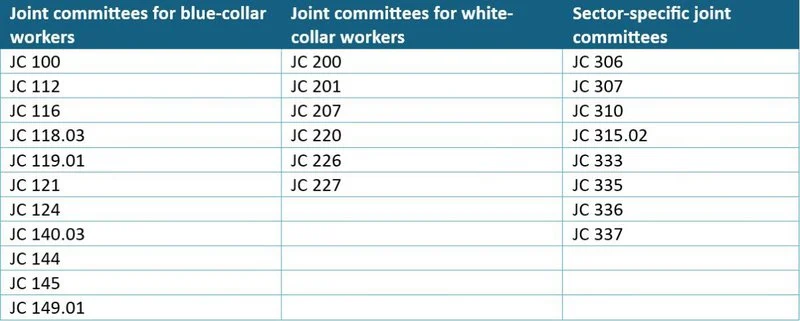
Here is a list of the joint industrial committees (sectors) applicable to Pro-Pay clients for which a sector-specific agreement has been adopted:

Table of joint committees for blue-collar, white-collar and sector-specific workers

Upon the adoption of the sectoral agreements, either a newsletter was distributed or a communication was sent directly to you.

3. Measures announced pending final approval

Below is an overview of the main measures currently under development, whose entry into force remains subject to the adoption of final legislation:

  • Mandatory introduction of a mobility budget from 2027 for companies employing at least 50 employees, and from 2028 for companies employing at least 15 employees;
  • Implementation of the Individual Learning Account (ILA) as a tool for recording trainings completed by employees;
  • Annualization of working time, consisting of calculating the average working time over a reference period of one year;
  • Extension of the solidarity contribution payable by employers with at least 50 employes on average for employees aged 18 to 54 who have been incapacitated for work for more than 30 days (see table above). This contribution will be extended to cover the 4th and 5th months of incapacity;
  • Introduction of 5 additional days of leave per child and per family, in addition to the existing maternity leave and birth leave schemes. The entitlement would be granted as a priority to the father or co-parent.

This list may be amended as legislative work progresses and further measures are developed.

Corporate housekeeping – Summer edition

Corporate housekeeping – Summer edition

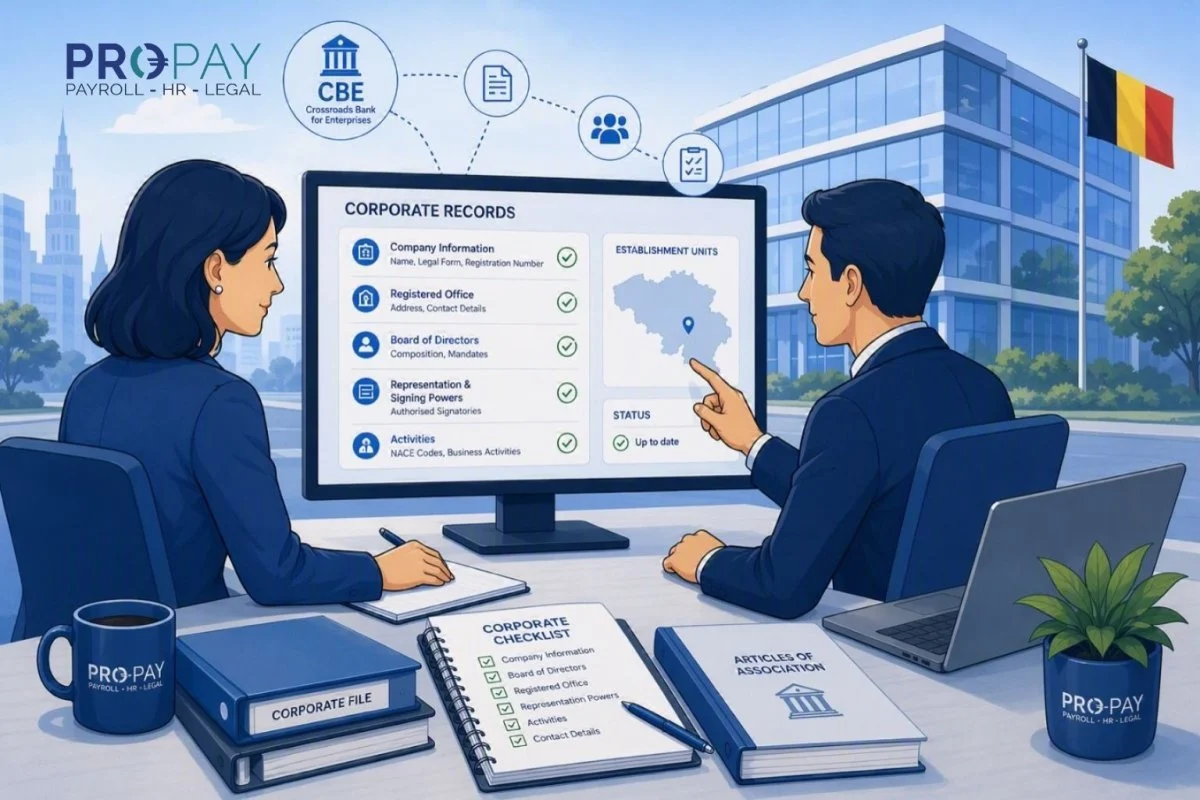
Are your corporate records in Belgium up to date?

Summer is often the perfect time to take a step back and ensure that your company’s records are up to date.

Whether you are a Belgian company, a foreign company active in Belgium, or a foreign company operating through a Belgian branch, it is essential to ensure that the information registered with the Belgian authorities is accurate and current.

Beyond the update obligations set out in the Belgian Code of Economic Law, inaccurate or outdated information may lead to practical difficulties and administrative delays.

Why should you perform a summer check-up?

  • Ensure legal compliance

Information registered with the Crossroads Bank for Enterprises (CBE) should be accurate and kept up to date in accordance with the requirements of Book III of the Belgian Code of Economic Law.

  • Avoid administrative bottlenecks

Outdated information may complicate access to Belgian government platforms, dealing with financial institutions and interactions with public authorities.

  • Facilitate corporate operations

Keeping your records up to date can help prevent issues in connection with corporate restructuring, financing transactions, acquisitions, due diligence exercises etc.

Our recommendations for review:

For Belgian companies

  • Composition of the board of directors;
  • Representation and signing powers;
  • Registered office address;
  • Activities registered with the CBE;
  • Contact details.

For foreign companies

  • Information relating to the foreign entity (address of the registered office abroad, company name, etc.) ;
  • Authorised representatives in Belgium;
  • Correspondence address and contact details;
  • Activities carried out in Belgium.
  • Registration of an establishment unit in case an office or co-working space is rented for employees

For foreign companies with a Belgian branch

  • Branch manager(s);
  • Representation powers;
  • Branch address;
  • Information registered with the CBE (address of the registered office abroad, company name, etc.);
  • Registration of an establishment unit in case an office or co-working space is rented for employees;
  • Consistency between the Belgian records and the foreign commercial register.

Did you know?

It is not uncommon for Belgian registers to still refer to:

  • A former director;
  • An outdated address;
  • Representation powers that no longer reflect the actual situation.

These discrepancies may go unnoticed for years until urgent corporate or administrative action needs to be taken.

Action point

Before the summer break comes to an end, take a few minutes to verify that your company’s records (or those of your Belgian branch) as registered in the Belgian Crossroads Bank for Enterprises are up to date and accurately reflect your current corporate structure.

Pro-Pay can provide tailored support, identify any required changes and manage the necessary updates on your behalf. You can contact us via legal@propay.be.

A simple check today can help you avoid complications tomorrow.