What about voluntary overtime as of 1 April 2026?

What about voluntary overtime as of 1 April 2026?

It is no longer a mystery that the federal government is actively implementing the measures set out in its 2025 government agreement.

In our newsletter of 19 January 2026, we already provided an initial overview of the measures planned for 2026, including the introduction of a single system of voluntary overtime, scheduled to enter into force on 1 April 2026. However, the applicable legislation is still pending. It is now expected to be approved only at the end of April, but with retroactive effect as of 1 April 2026.

A unified system

As a reminder, this new system will merge the “classic” voluntary overtime hours and the “relance” overtime hours into one single framework.

For further details, we refer to our dedicated newsletter of 19 January 2026.

What you can do as of 1 April 2026

Pending the adoption of the new legislation, the following rules in principle apply as of 1 April 2026:

  • maximum of 120 ordinary voluntary overtime hours per calendar year;
  • these hours must be paid out with an overtime supplement, and they are subject to social security contributions and taxes;
  • they require a written agreement to be concluded in advance, which is valid for a maximum of six months

Unlike ordinary voluntary overtime hours, relance overtime hours were a temporary measure that has already been extended several times. The regulation governing relance overtime was extended for the last time until 31 March 2026. As a result, the current rules on relance overtime hours can no longer be applied as of 1 April 2026.

Pending the official publication of the law introducing the new unified system, employers may already choose to conclude a new agreement based on the new system after 1 April 2026. As long as the law has not yet been formally adopted, this does involve a legal risk, although that risk appears limited since the legislation is almost certain to apply retroactively from 1 April.

We will of course keep you informed as soon as the law is approved and published in the Belgian Official Gazette.

Other planned legislative changes

Below you can find an overview of the other planned legislative changes, currently scheduled for 1 June 2026:

  • Simplification of the rules regarding the inclusion of all full-time working schedules in the working regulations
  • Reform of the minimum weekly working time for part‑time employees: from 1/3rd to 1/10th
  • Abolition of the prohibition on night work
  • Limitation of the maximum notice period to 52 weeks
  • CLA 90 bonus: mandatory electronic filing
  • Limitation of the indexation (the “centimes-index”)

In addition, the flexi‑job system would also be expanded to all sectors as of 1 April 2026. This measure has also been postponed. The exact date of entry into force is not yet certain, although 1 July 2026 is currently considered the most likely date.

Split payroll arrangement: key considerations

Split payroll arrangement:  key considerations

One of the ongoing consequences of the COVID-19 pandemic is the wish of many employees to telework, at least partially, from home. It is fairly straightforward to implement this if the employee resides in the same country as that in which their employer is established.

The situation becomes more complex if the employee resides in another country and partially teleworks in their home country (the so-called home office) and partially in the country where the employer is established. Such a situation is commonly referred to as an “informal” split payroll arrangement.

This is a variant of the “formal” split payroll arrangement pursuant to which an employee works in two (or more) different countries to the benefit of two (or more) different employers.

Physically performing employment functions in different countries can have far-reaching consequences. We herewith outline the most relevant points of attention.

  1. Applicable social security

A split payroll arrangement implies that an employee works on an alternating basis over a longer period of time in different countries.

In an EU-context the home country social security regime will apply if the employee performs at least 25% of their working time in the home country. This may lead to a situation whereby the employer established in another country is to register with the employee’s home country social security administration.

Many employers consider this a hindrance. As a result, a framework agreement has been concluded effective 1 July 2023. Pursuant to the framework agreement an employee can remain covered by the social security regime of the country where the employer is established provided that they telework less than 50% in the home country. See our newsletter regarding the entry into force of the framework agreement for an overview of all conditions.

If the split payroll arrangement covers a third country, it has to be verified whether there is a social security treaty.

In the affirmative (e.g. the US, Canada, etc.) one will typically have to contribute towards the social security regime of both countries, depending on the split of working time and salary between the countries.

Absent a social security treaty with Belgium, the employer may decide to maintain Belgian social security coverage or, possibly, to apply the overseas social security regime. However, at a local level it always needs to be verified whether the employee is also subject to local social security contributions.

! Several European countries have a mandatory notification system in respect of employees who work part-time on their territory and who do not contribute to the local social security regime. Always check if the country where your employee works on an alternating basis has such a notification system. See our newsletter about the introduction of such a mandatory notification system in the Netherlands.

  1. Applicable tax regime

With regard to professional income, employees are as a matter of principle taxable on their worldwide income in the country where they are resident for tax purposes. As an exception to this rule, if an employee physically works in the country where their employer is established and is paid by their employer, they will become liable for taxes in the employer’s country.

We recommend having each scenario thoroughly analysed by a tax advisor. If an employee becomes taxable in another country, this will indeed have implications on a salary administration level (wage tax withholding and/or reporting).

More specifically in the framework of an informal split payroll arrangement (telework) the question arises as to whether the home office in the employee’s home country can be considered a permanent establishment of the employer in which case there may be ramifications on a corporate income tax level. Again, specialised tax advice will be needed.

  1. Work accident insurance

In the framework of a split payroll arrangement, it will always have to be verified whether the employee is covered or must be covered by a work accident insurance for each portion of their employment and in each country.

Always check beforehand with your insurance company whether this can be coordinated, and whether additional formalities/premiums apply.

  1. Applicable labour law

As a rule, parties are free to choose the labour law applicable to the employment relationship. However, there are limits to this choice of law. These are linked to the place(s) where the employee performs their activities and local law that has to be complied with. It is recommended that you check beforehand with your legal advisor so that the split payroll arrangement can already start with the correct contractual documents.

  1. Immigration

If the employee works in another country, it also needs to be verified whether they have the right to work in that country on an alternating basis. It is recommended that you obtain advice in a timely manner and, if need be, to start up the procedure well in advance in light of the fact that the processing time can easily take a few weeks, if not a few months.

A thorough analysis covering different angles is required prior to implementing a split payroll arrangement. Indeed, as from the start all pieces of the puzzle must fit together so as to avoid unpleasant surprises down the road which affect the employer(s) and/or the employee.

Private Investigation Act: an update

Private Investigation Act: an update

In our newsletter of 3 April 2025, we informed you about the publication of the Private Investigation Act (“PIA”) and its impact on HR personnel. Nearly a year has passed since then. With this newsletter, we would like to provide you with an update and remind you of the upcoming obligations that must be complied with under the PIA.

Does an HR department that only occasionally performs private investigation activities fall within the scope of the act?

In our newsletter from last year, we briefly discussed the debate on whether HR services that only occasionally carry out private investigation activities fall within the scope of the PIA.

It is now generally accepted that these HR services fall within the scope of the PIA. Except for the permit requirement, they need to follow the PIA rules as well. At the same time, it is still unclear whether all the requirements, like drafting certain investigation documents, actually apply to these HR services.

First case law on the Private Investigation Act at the workplace

The importance for employers to comply with the provisions of the PIA is further demonstrated by the first case law regarding the application of the PIA at the workplace, which dates from the end of last year.

In this case, the employer engaged an external private investigator during an investigation into the dismissal due to urgent reasons of a protected employee. The court found, however, that the rules of the PIA had not been complied with during this investigation. As a result, both the investigation by the external private investigator and the resulting investigation report were declared null and void and could not be used in the proceedings. Without these documents, the employer was unable to sufficiently demonstrate the urgent reason, as a result of which the court ultimately ruled that it had not been proven. On appeal, the court of appeal confirmed that the investigation report had to be disregarded due to a violation of the PIA, but nevertheless ruled that the remaining evidence did establish an urgent reason.

It is now generally accepted that these HR services fall within the scope of the PIA. Except for the permit requirement, they need to follow the PIA rules as well. At the same time, it is still unclear whether all the requirements, like drafting certain investigation documents, actually apply to these HR services.

What does this mean in practice?

Taking the above into consideration, it is now more important than ever to ensure that your HR practices regarding the collection and examination of information about applicants and employees are fully compliant with the applicable regulations. We refer to our newsletter of 3 April 2025 for a brief overview.

In addition, we recommend getting all the documents required under the PIA in order on time.

More specifically, this means in the first place that regulations on private investigations must be drawn up. As a reminder, the PIA stipulates that the authorisation and modalities of private investigations must be included in such regulations.

The law stipulates a period of two years for this, which means that the deadline is 16 December 2026. If a private investigation is carried out after that date without regulations having been drawn up, all findings from that private investigation will automatically be considered null and void.

When you, as an employer, actually carry out a private investigation, additional documents often need to be drawn up. Which documents exactly, depends on who is conducting the investigation, for example an external private detective or an internal employee, as well as the specific investigative actions that are being carried out.

How can Pro-Pay assist you?

We are happy to assist you in preparing the necessary documents or providing templates. Of course, we are also available to answer any questions you may have about the PIA.

If you have any questions about this service or the associated fees, please do not hesitate to contact us at legal@propay.be.

New increase of office allowance as from 1 March 2026

New increase of office allowance as from 1 March 2026

Employees who work from home on a structural and regular basis can receive a lump-sum reimbursement from their employer. The maximum amount of this allowance has been increased on 1 March 2026 from 157.83 EUR per month to 160.99 EUR per month.

Office allowance increase

As costs related to homework are relatively small and difficult to prove, the social security authorities (RSZ/ONSS) and the tax authorities accept to estimate these costs on a lump sum basis. The office allowance is intended to cover, among other things, costs for heating, electricity, water, insurances, office supplies and refreshments.

The social security authorities have indicated in their intermediary administrative guidelines that the office allowance is indexed again. The maximum amount of 157.83 EUR has been increased to 160.99 EUR per month as of 1 March 2026.

The tax authorities follow the amount of the office indemnity as determined by the social security authorities, as well as the evolution of this amount. The amount of 160.99 EUR is therefore exempt from social security contributions and taxes.

The amount of 160.99 EUR is a maximum amount. It is therefore not mandatory to grant this maximum amount, but you are free to increase the amount to 160.99 EUR per month as of 1 March 2026.

We would also like to remind you that a written agreement must be drawn up for teleworkers, in principle at the latest when the employee starts teleworking. In this agreement, specific mandatory provisions must be included, such as the place where the telework will be performed, how the costs will be reimbursed, etc.

Other indemnities for homework

In addition to the office allowance, the employer can also reimburse the following costs on a lump sum basis:

  • 20 EUR per month if the employee uses his/her own internet connection for professional purposes.
  • 20 EUR per month if the employee uses his/her own computer for professional purposes.
    OR 10 EUR per month (5 EUR per item) for the professional use of a personal second computer screen and printer/scanner (and this for a maximum of 3 years). Attention, this allowance cannot be combined with the lump sum of 20 EUR per month for the use of the own PC.

These indemnities have not been increased: the maximum amounts remain the same.

The lump sum amounts can of course only be granted if the office and internet costs are not yet reimbursed to the employee in another way.

Action point

Inform your Payroll Business Partner if you wish to increase the current lump-sum office allowance. The increase is not mandatory.

Impact train fare increase on commuting – 2026

Impact train fare increase on commuting - 2026

On 1 February 2026 the subscription fees for the train (NMBS/SNCB) have been increased. In this newsletter, we would like to inform you of the impact of these increases for you as an employer.

First of all, we repeat in a nutshell the general principles that determine whether you, as an employer, are obliged to contribute to the commuting costs of your employees:

  1. For employees who come to work by public transport, the employer is obliged to pay a contribution as from the 1st kilometre. All employers are subject to a minimum contribution, laid down at the level of the National Labour Council (CNT/NAR). Within the National Labour Council, a collective bargaining agreement was concluded that determines the employer’s contribution based on lump sums. These amounts have been adjusted by the collective bargaining agreement no. 19/11 of 8 April 2024. This collective bargaining agreement also introduced a system of automatic increase in the employer’s lump-sum contribution whenever the prices of NMBS/SNCB train tickets increase.
  2. For employees who come to work by bicycle, the employer is obliged to pay a bicycle allowance. Since 1 May 2023, the employees belonging to a sector that has not concluded a collective bargaining agreement on bicycle allowances or employers that have not concluded a company collective bargaining agreement must grant the bicycle allowance imposed by the National Labour Council, the indexed basic amount of which amounts to 0.30 EUR (indexed amount 2026) per kilometre.

    This bicycle allowance is exempt from social security contributions and taxes up to a certain amount. Since 1 January 2026, the maximum exempt amount is 0.37 EUR per kilometre. Moreover, the annual threshold of 2,500 EUR has been increased to 3,700 EUR (for the calculation of the withholding tax, an amount of 3,690 EUR will, however, be taken into account) since 1 January 2026. The part of the annual bicycle allowance exceeding the threshold will be subject to social security contributions and withholding tax.
  3. For employees who come to work by their own means of transport (e.g. car), it should be checked whether a contribution has been determined at sector level.

As you can read below, increases of the fares of the public transport companies do not affect every employer.

Train

As from 1 February 2026, the NMBS/SNCB increased its ticket fares by 2.14%. The rates for the train subscriptions have been increased by 2.60%. Whether you, as an employer, have to contribute to this increase in fares, depends on the joint industrial committee (sector) to which your company belongs, and the collective bargaining agreements that were concluded in this joint industrial committee:

  • Your sector does not stipulate anything about the contribution to commuting costs or refers to the general minimum regulation provided for by the National Labour Council: your contribution has been increased based on the amounts of the collective bargaining agreement no. 19/11 of 8 April 2024 and will be increased automatically once the rail fares increase.
  • Your sector provides for the employer’s contribution to be equal to a percentage of the actual rail fares: your contribution will increase.
  • You make use of a third-party payer agreement whereby you as an employer pay a contribution of 80% of the actual price of the train season ticket to the train company and the state pays the remaining 20%: your contribution will increase.

Metro, tram, bus, waterbus

Does your employee travel to work by metro, tram, bus or waterbus? First of all, check whether your sector has stipulated anything for this reimbursement.

If your sector does not stipulate anything, the price increases will have an impact on your contribution to the commuting costs, depending on which of the following regulations applies:

  1. Is the cost of the ticket linked to the distance travelled? Then the employer’s contribution is calculated on the basis of the fixed lump sums of the railway transport, but the contribution is limited to 75% of the actual transport cost.
  2. Is the cost of the ticket not linked to the distance? The contribution of the employer is 71.80% of the actual transport cost, not exceeding the lump sum provided for the train for a distance of 7 kilometres.

The CBA no. 19/11 removed the minimum distance requirement of 5 kilometres.

Private transport

Does your employee come to work using his own car or by foot? A mandatory contribution to private transport is not provided for by the National Labour Council. Therefore, the employer’s contribution for private transport is often provided for at sectoral or company level. If your sector refers to the lump sums of the railway transport, your employer’s contribution will not increase. However, some sectors refer to a percentage of the actual train fares. In this case, the employer’s contribution to the commuting costs will increase.

Does your employee come to work by bicycle? Then price increases of the NMBS/SNCB will have no impact on your contribution to the commuting costs.

Combined public transport

Your employee combines the train with one or more other means of public transport? First of all, check the regulations in your sector.

If your sector does not stipulate anything and if only one ticket has been provided for the whole distance, the employer’s contribution is calculated on the basis of the established lump sums of the railway transport. If several tickets are provided, the employer’s contribution must be calculated separately for each means of public transport. These employer contributions must be added together.

Action point

If your contribution for the commuting costs of your employees increases, we will automatically calculate the correct contribution for you. If there are any changes in the means of transport your employee uses for their commuting travel, do not forget to inform your Payroll Business Partner in due time.

The training plan: don’t forget the approaching deadline for electronic submission

The training plan: don’t forget the approaching deadline for electronic submission

Since the Labour Deal, employers with at least 20 employees must establish a formal training plan each year.

More information on what must be included in this formal training plan, can be found in this newsletter.

The draft training plan must first be shared with the Works Council, or in absence thereof the union delegation, or in absence thereof the employees every year by 15 March at the latest. The final training plan must then be established by 31 March at the latest.

Once the final training plan is established, the training plan must be submitted electronically via the application https://www.transfer.werk.belgie.be/.

Deadline

The training plan must be submitted within one month after the plan enters into force. This means that the training plan for 2026 has to be submitted by 30 April 2026 at the latest.

If you have any further questions about this topic, do not hesitate to contact us via legal@pro-pay.be.

FLA out, ILA in: what remains the same and what will change?

FLA out, ILA in: what remains the same and what will change?

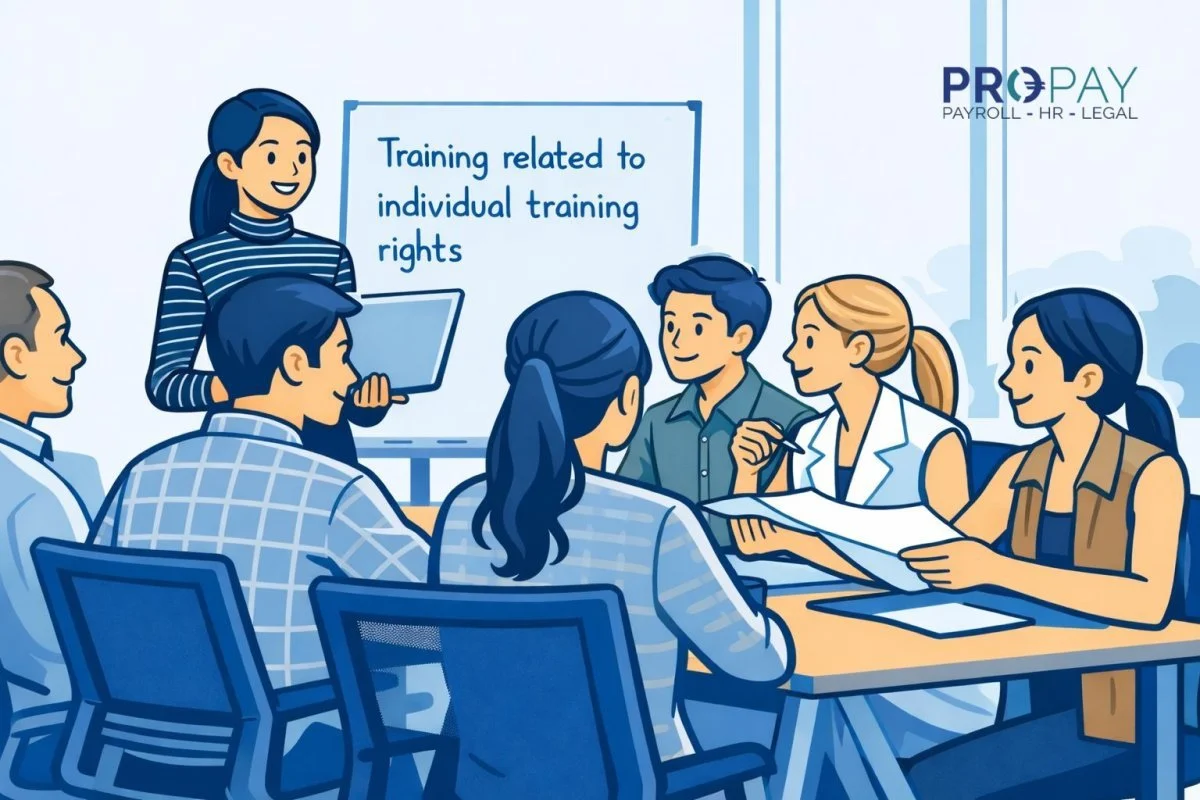
After several postponements of the obligation to register training courses in the Federal Learning Account (FLA), the federal government has finally decided to abolish the FLA definitively as of 1 January 2026.

The data already registered in the FLA will remain available for the time being, to allow it to be downloaded and transferred to other systems. However, no new data can be added. On 1 January 2027, this data will be permanently deleted.

Meanwhile, the replacement of the FLA by the Individual Learning Account (“ILA”) has been announced, effective 1 January 2027. Every citizen will be able to consult an overview of their training courses, degrees and certificates through the ILA’s secured digital platform.

This new system will be less administratively burdensome for employers. Under the FLA, employers had to register all their employees’ training courses themselves. Under the ILA, employers will no longer be involved: degrees and certificates from recognised training institutions will be added automatically, while citizens will only have to add training courses from non-recognised training institutions themselves.

The government will communicate over the course of this year how the registered data can be retrieved and, potentially, transferred to the ILA.

Obligations regarding training rights in 2026

The abolition of the FLA also means the end of the obligation to register training courses in an individual training account as of 1 January 2026.

However, as the individual right to training remains in place, we recommend to keep internal records of the followed training courses and the training rights of each employee until the introduction of the ILA.

In addition, the obligation for companies with 20 or more employees to draw up and register an annual training plan will also remain in force.

More information about the individual training rights and the obligation to draw up an annual training plan can be found in our newsletters of 12 March 2024 and 17 February 2025.

If you have any questions about any of the above topics, please do not hesitate to contact us at legal@pro-pay.be.

No sectoral agreement 2025-2026 for Joint Industrial Committees 209 and 111

No sectoral agreement 2025-2026 for Joint Industrial Committees 209 and 111

In Belgium, social dialogue takes place at three levels: interprofessional/federal, sectoral and company level. In recent months, the wage norm as well as various employment-related measures have been introduced at federal and interprofessional level, thus serving as a basis for sectoral negotiations.

As usual, sectoral negotiations for joint committees 209 and 111 were conducted together. However, these sectoral negotiations did not result in a sectoral agreement for the years 2025-2026, which is highly unusual.

What came before

At the end of last year, it had already become clear that the positions of the social partners within these joint committees differed greatly. After two rounds of negotiations in December 2025, the parties left without reaching an agreement. Shortly afterwards, the trade unions submitted a strike notice, with a start date of 15 January 2026.

Ultimately, it was agreed to resume sectoral negotiations on 23 January 2026. However, even during this new round of negotiations, no agreement could be reached.

What does this mean for the companies within these Joint Industrial Committees?

Since no agreement was reached at the sectoral level, social dialogue must now continue at company level.

These company level negotiations will have to take into account the wage norm (= the maximum wage cost development), which is set at 0% for the period 2025-2026. Within this framework, it is possible to negotiate benefits that fall outside the wage norm.

One example is an increase in meal vouchers. A company can implement such increase at company level, provided that an annex to the employment contract is concluded for each individual employee. For more information on this subject, please consult our newsletters of 20 November 2025 and 19 January 2026.

The non-recurring result-related bonus (“wage bonus CLA 90”) and profit participation bonus are also not taken into account for the wage norm. More information on this subject can be found in our newsletter of 27 January 2026.

What about the social peace?

A sectoral agreement usually includes a clause on social peace in which the social partners commit themselves to not make any additional demands at sectoral or company level on the matters covered by the sectoral agreement.

In the absence of such a clause, it is possible that companies may be confronted with strike notices from trade unions during further negotiations.

If you have any questions about this topic, please do not hesitate to contact us via legal@pro-pay.be.

Impact of the Act concerning a strengthened return-to-work

Impact of the Act concerning a strengthened return-to-work

On 30 December 2025, the Act implementing a reinforced return-to-work policy in case of incapacity for work was published in the Belgian Official Gazette. The new Act will introduce several important changes. These measures aim to strengthen the prevention of long-term absenteeism and reintegration of employees. The foundation of this plan is to increase the accountability of the various key players involved (employees, employers, and health insurance institutions).

Below is an overview of the key impacts for employers:

1. Active absence policy – amendment of the working regulations

As part of long-term absence prevention, employers are required to implement a policy aimed at preventing absenteeism. This policy notably includes the establishment of a concrete procedure for initiating and maintaining contact with employees during periods of absence. The specific modalities of this procedure must be formally incorporated into the company’s working regulations as a new mandatory provision, which will therefore need to be updated accordingly. Where applicable, the Prevention and Protection at Work Committee must also be consulted in accordance with the applicable legal requirements.

We would be happy to support you should you require assistance in updating your working regulations.

Date of implementation: 1 January 2026

2. Solidarity NSSO contribution for long-term absences

The Act introduces more a quarterly solidarity contribution for employers with an average of 50 employees. The contribution equals 30% of the incapacity for work benefit for a period of two months (i.e. the second and the third month, after the 30 days of guaranteed salary) . This contribution is due to the NSSO (National Social Security Office) in case of absence of an employee aged 18 to 54. The contribution is automatically calculated and collected by the NSSO, on the basis of information provided by the competent health insurance fund. The NSSO determines the amount due and recovers it via a debit notice, together with the regular social security contributions for the third quarter following the quarter in which the illness began.

The contribution is not payable in case of the illness of specific categories of employees such as for example temporary workers, flexi-job employees and occasional workers in certain sectors.

Date of implementation: periods of incapacity for work occurring as from 1 January 2026.

3. Exemption from providing a medical certificate

As you may know, companies with 50 employees or more are required to apply the rule allowing employees to take one day of absence without a medical certificate, up to three times per year. Smaller companies may choose to explicitly opt out of this rule in the working regulations if they wish.

As a new measure, the Act reduces the number of times an employee can be absent without providing a medical certificate from 3 to 2 per year.

If your company intends to apply this stricter regime, you will need to amend your working regulations if they explicitly refer to the previous three-day requirement. Of course, you may always apply more favourable rules and continue allowing up to three uncertified days instead of two.

Date of implementation: 1 January 2026

4. Medical force majeure

Under Belgian law, an employment contract could be terminated on the grounds of medical force majeure when an employee is unable to perform their work due to prolonged illness or incapacity. As part of this procedure, there will be an assessment whether the employee can resume their original duties or perform suitable alternative work. If it is determined that the employee cannot return to work in any adapted role, the employer may proceed to terminate the contract on the grounds of medical force majeure.

Under the new Act, the uninterrupted period of work incapacity required to initiate the procedure for terminating a contract due to medical force majeure is reduced from 9 months to 6 months.

The waiting period before a new procedure can be initiated is also reduced to 6 months.

Date of implementation: 1 January 2026.

5. Increased relapse period from 14 days to 8 weeks for the entitlement to guaranteed salary

Under Belgian employment law, employees are entitled to a guaranteed salary for the first 30 calendar days of incapacity for work. A “relapse” is deemed to occur when an employee becomes incapacitated again for the same underlying reason within 14 calendar days following a previous period of incapacity that already triggered the guaranteed salary. In the event of a relapse, the employee is not entitled to a new guaranteed salary period.

The relapse period has been extended to 8 weeks. No new guaranteed salary period will start if an employee becomes incapacitated for the same cause within 8 weeks following the end of a previous incapacity period that gave rise to guaranteed salary.

Date of implementation: 1 January 2026, applicable to work incapacity occurring from that date onwards.

6. Partial work resumption and neutralisation of guaranteed salary

Previously, in case the employee was allowed to resume work partially, there was a limit of 20 weeks during which the guaranteed salary was neutralized in case of new full-time incapacity to work during the partial work resumption. After that period the employee was again entitled to guaranteed salary.

This 20-week limitation has been removed, meaning that the neutralisation of guaranteed salary will apply for the entire duration of the partial work resumption. The employee will therefore immediately fall back on the health insurance fund if they become ill during a partial work resumption.

Date of implementation: 1 January 2026, applicable to incapacity for work occurring from that date onwards.

7. Work potential assessment and new sanction included in the social criminal code

In January 2026, the Code of Wellbeing at Work was amended to introduce an obligation for employers to request an assessment of the employee’s “work potential” in the event of incapacity for work. This assessment is carried out by the prevention advisor-occupational physician, based on information provided via a standardised form. The employer may request this assessment no earlier than eight weeks after the start of the incapacity for work.

Where the assessment concludes that the employee has work potential, employers with at least 20 employees are required to initiate a reintegration process within six months following the start of the incapacity for work.

These obligations apply to all incapacities for work starting as from 1 January 2026.

In addition, the Act of 19 December 2025 introduces a new level 2 sanction under the Social Criminal Code. This sanction applies to employers with at least 20 employees who fail to request the occupational physician to initiate a reintegration process within the prescribed timeframe (6 months).

Date of implementation: 1 January 2026.

Action points

This legislative reform represents a significant shift in Belgium’s approach to long-term incapacity and reintegration. Employers will face new obligations, increased administrative follow-up, and potential financial consequences for non-compliance. Updating internal policies—particularly the work regulations—and preparing HR teams for these new requirements will be essential to ensure full compliance by January 2026.

If you require support in assessing the impact on your company or adapting your internal documents, we remain at your disposal.

Sectoral agreement 2025-2026 for the Joint Industrial Committee 226

Sectoral agreement 2025-2026 for the Joint Industrial Committee 226

In Belgium, social dialogue takes place at three levels: interprofessional/federal, sectoral, and company level. In recent months, the wage norm as well as various employment-related measures have been adopted at the federal and interprofessional levels, thereby serving as a basis for sectoral negotiations.

These negotiations were conducted within Joint Committee 226, resulting in a sectoral agreement protocol for the years 2025–2026 (valid from 1 January 2025 to 31 December 2026). Below, we provide an overview of the most important decisions applicable to your sector for the year ahead.

1. Meal vouchers: Progressive increase in the employer’s contribution

The employer’s contribution to meal vouchers will be increased progressively in 2026:

  • EUR 1 as of 1 February 2026, followed by
  • an additional EUR 1 as of 1 December 2026.

As of 1 December 2026, the total increase in the employer’s contribution will amount to EUR 2 per meal voucher.

Employers who have already granted an increase in meal vouchers in 2026 prior to the entry into force of these sectoral increases may deduct such increase from the sectoral increase.

2. Year-end premium

Within the sector, it is possible to convert part of the fixed component of the year-end premium into an equivalent benefit.

As from 1 January 2026, the convertible portion will be increased to 60% of the fixed part of the year-end premium (previously 50%).

In addition, this conversion will no longer be limited to benefits related to well-being and/or (green) mobility but may cover a broader range of equivalent benefits (which could notably be implemented through a cafeteria plan).

3. Mobility

Private transport

As of 1 January 2026, the employer’s contribution to private transport costs, based on the flat-rate scale, will be indexed by 5.8%.

Bicycle allowance

As from 1 January 2026, employees who regularly commute to work by bicycle will be entitled to a bicycle allowance of EUR 0.30 per kilometer travelled.

4. Time credit

The time credit scheme with motive (taken full-time or half-time) will be extended for the period from 1 July 2025 to 31 December 2027.

The end-of-career jobs scheme will be extended for the period from 1 January 2026 to 31 December 2027.

As from 1 January 2026, the sector increases the supplementary allowance financed by the Social Fund for employees benefiting from a career reduction.

The new amounts are set as follows:

  • 1/5 reduction: EUR 110, as from the age of 60 in the case of a reduction under National Labour Council CBA No. 103, and as from the age of 55 in the case of a long career, heavy work or night work;
  • 1/2 reduction: EUR 130, as from the age of 55 in the case of a long career, heavy work, night work or in the case of time credit with motive.

5. Additional allowance – Youth and senior holidays

The employer is required to grant a supplementary allowance, in addition to the allowance paid by the ONEM, to employees making use of the youth or senior holiday scheme.

As from 1 January 2026, the amount of this supplementary allowance will be increased to:

  • EUR 18 gross for a half day of holiday;
  • EUR 36 gross for a full day of holiday.

The employer may recover this amount from the Social Fund.

6. Miscellaneous

Hiring bonus

Under certain conditions, companies may benefit from a lump-sum hiring bonus financed by the Social Fund for each employee hired who was previously dismissed by another company in the sector, or in the case of hiring a young worker under the age of 26.

As from 1 January 2026, the amount of these hiring bonuses will be increased to EUR 3,000.00.

Job classification

The functions of railway companies will be added to the existing job classification system.

Training subsidy credit for training not covered by LOGOS

For training courses for which LOGOS does not provide free training and which are organised by the employer with an operator of its choice, it is possible to apply for a subsidy credit per calendar year.

The amount of this credit is determined per employee and varies according to the size of the company:

  • for companies employing up to 10 employees, the credit amounts to EUR 110 per employee;
  • for companies employing more than 10 employees, the credit amounts to EUR 100 per employee.

As from 1 January 2026, these amounts will be increased to EUR 115 and EUR 105 per employee respectively.